TAPAS.network | 18 December 2025 | Commentary | Vincent Stops
London Bus use is going the wrong way – and the worrying thing is that TfL know why, but are not acting on it

London’s bus services were once the envy of the rest of the country. But not now. Compared with most other areas of the country which have seen recent growth, bus use in London continues to decline. TfL are looking at an eye watering £billion subsidy and a 23% decline in passenger journeys since peak bus in 2014, ironically then billed as the year of the bus. explains why he believes the capital’s own policies have been doing the damage – and how concerning it is that lessons have seemingly not been learned.
THE LATEST bus passenger figures issued by the DfT and reported in the last issue of LTT put London firmly at the bottom of the class.
New local bus statistics for Great Britain, including passengers, mileage, and vehicle fleet, for the year ending March 2025, show the number of bus passenger journeys increased by 1% in England - including by 4% outside of London, but decreased by 1% in London. This continues a concerning comparative trajectory since the Pandemic- and indeed before.
London’s bus system was until quite recently the one other areas wanted to emulate. “We want a bus service like London” said a succession of Metropolitan mayors. But maybe they haven’t taken a bus ride in the Capital recently?
In metropolitan areas, there was a 5% increase in the latest financial year compared with the year ending March 2024. In non-metropolitan areas, there was, a 3% increase over the same period. Due to the high volumes of bus use in the Capital, the disappointing London figures are what have dragged the overall national bus use total down. Indeed, the bus has long been the anchor of the London transport system and accounts for over half of all local bus passenger journeys in England, highlighting its unique reliance on bus transport.
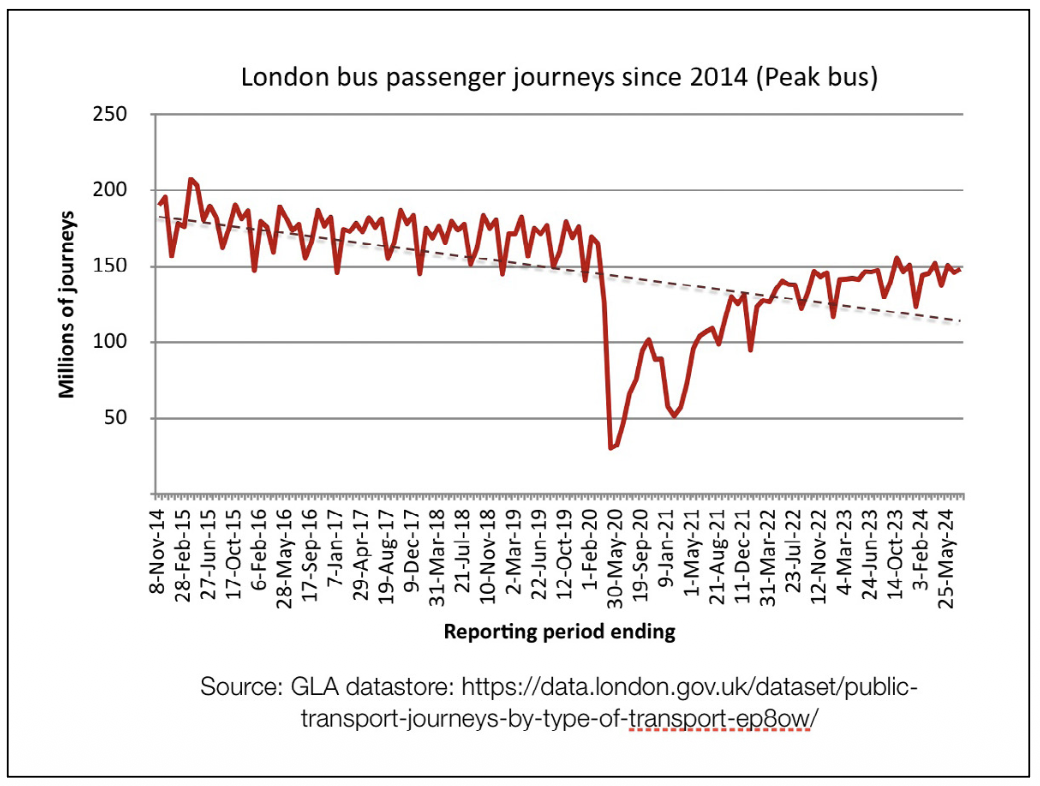
London bus demand peaked in 2014 - with patronage now back at 2005 levels. That means ten years of decline. But London’s population has grown by 1.2m people (14%) over that period, so in respect of bus trips per year per head of population (a good measure of bus demand), London has dropped by nearly 25%.
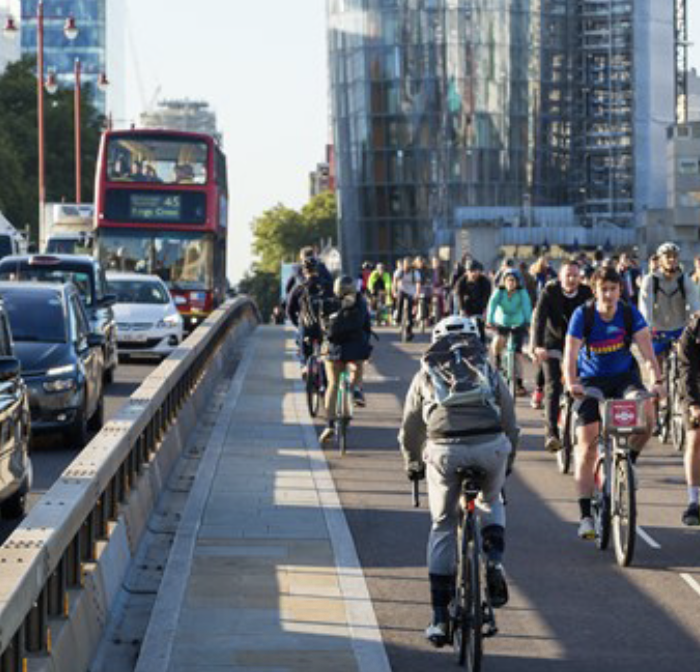
In a battle for road space: buses and bikes both have claims on highway capacity – but the key issue how to determine a fair allocation
The drop of bus use in London in the DfT figures matches the position revealed by recent Transport for London (TfL) data, and comes despite the general maintenance of service capacity and frequencies in the capital, but continuing problems with reliability and travel speed. Despite reduced services elsewhere, substantially below those pre-Covid, at 86% of the 2018-19 level for England outside London, the TfL bus service provision is still 97% of what it was before the Pandemic but TfL data show weekday bus usage at only 73-85% of the pre-COVID-19 baseline.
Bus service mileage increased overall by 2% across England in 2024/5, the DfT stats show, remaining broadly stable in London, but increased by 3% elsewhere.
So this big drop in patronage cannot reasonably be linked to a reduced quantum of bus product on offer. The explanation lies in quality, not quantity.
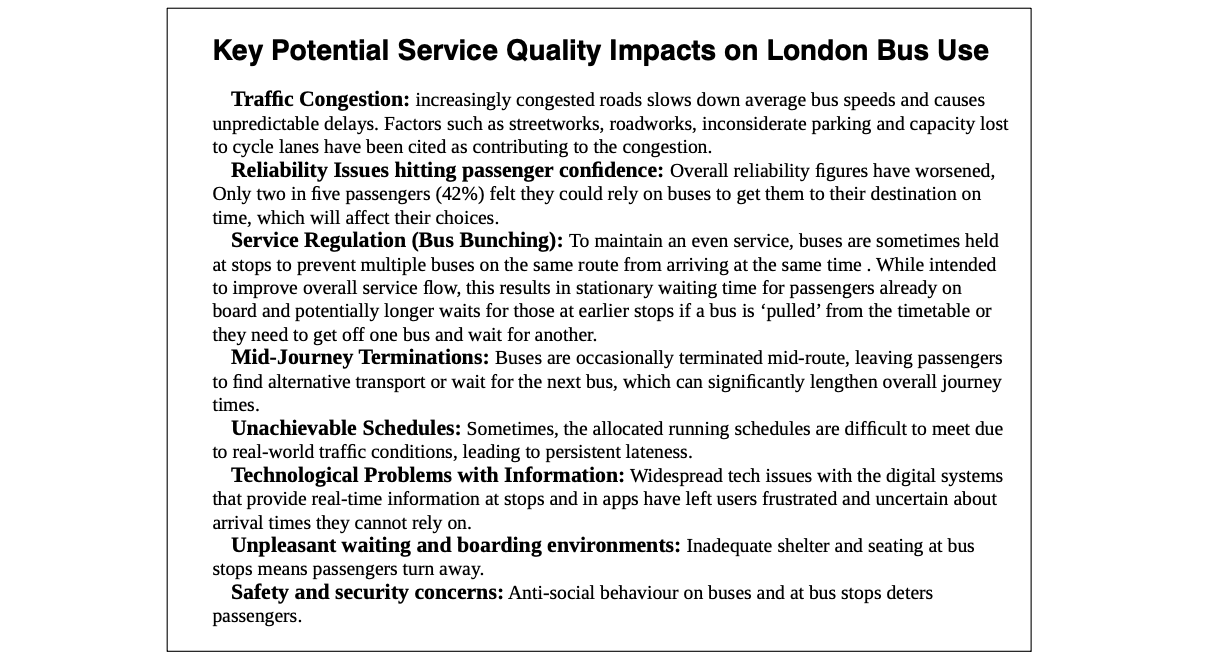
When passengers are asked about their priorities, reliability always comes top. The reasons are obvious. Whether commuting to work, parenting commitments, meeting friends, hospital appointments or getting to school; knowing a bus will arrive regularly and that you’ll get where you are going, in a reasonable time and not to be delayed on route, is fundamental to travel choice, if one has a choice.
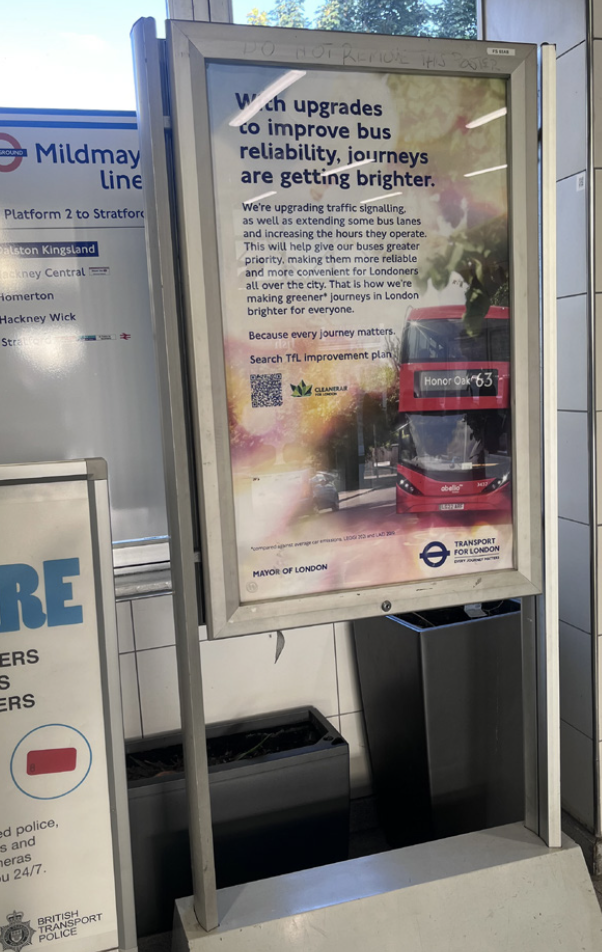
With upgrades to improve bus reliability, journeys are getting brighter” says Transport for London poster campaign. But is it true? Part of Brighter Buses Campaign by VCCP agency
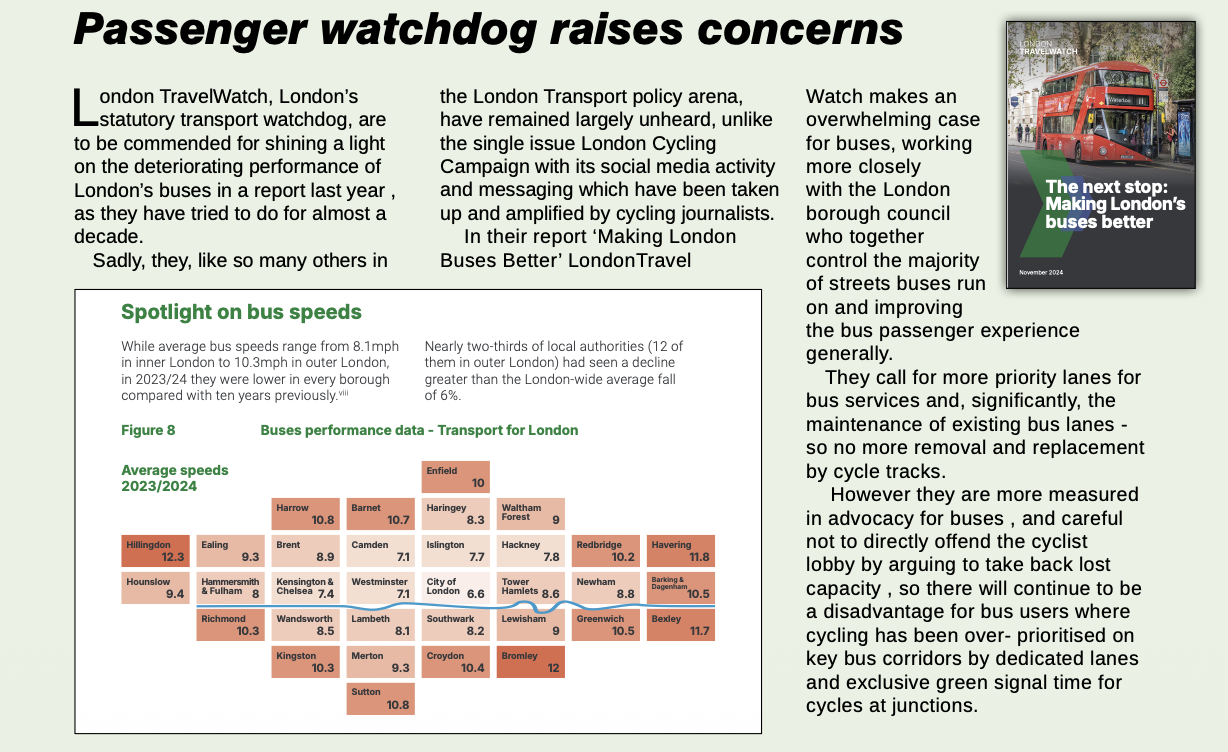
TfL has calculated that every 10pc worsening in journey time causes a 6pc loss in usage. Passenger watchdog London TravelWatch has also found that if London buses can travel just 1mph faster it could potentially save TfL between £100-£200m a year, as well as generating additional revenue of £80-£85m.
The London TravelWatch report on London buses in November 2024 emphasised journey time was the number one issue for passengers. It showed that 33 per cent of survey respondents said that slow buses stopped them from using the bus more often. Over a third also said that their top consideration when deciding whether to travel by bus was how fast the bus journey is.
So when I saw a TfL poster recently claiming ‘bus reliability is improving and journeys are getting brighter’, it angered me enough to refer it to the Advertising Standards Authority. That poster may be cleverly worded, but it isn’t truthful. You have to go back to the very early days of Ken Livingstone’s mayoralty in the noughties to find bus reliability figures that are as poor as those that are now being reported alongside the reality of significant long term passenger decline.
Transport for London was established in 2000 and has celebrated its quarter century this year. It was incredibly proud of its first decade and what had been achieved in a remarkably short space of time across the patch and particularly for bus passengers.
But whatever else may have been achieved in the subsequent decade and a half, its record on buses is very poor.
A tale of three mayors and their chosen modes

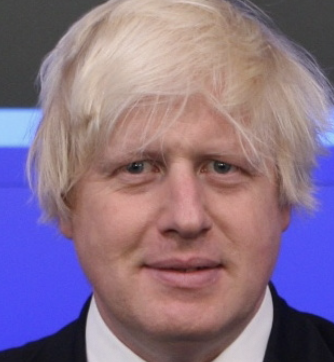
The first London mayor Ken Livingstone pursued strongly pro- bus policies, but his successor Boris Johnson was most keen on bikes and greater provision for them. When Sadiq Khan took over, he continued with Johnson’s cycle superhighway plans
The chart of ‘Excess Waiting Time’ dramatically demonstrates the long term improvements in bus reliability in the late 1990s and early 2000s. This was delivered initially by an active Government Office for London before control went back to the Mayor and Greater London Authority and then TfL itself, with the average time every London bus passenger waited beyond the scheduled time cut by half.
Mayor Livingstone understood what mattered to bus passengers and focused TfL on reliability. He used a combination of measures to achieve this aim, both physical and financial. At the heart of Livingstone’s policies was the so called ‘Quality Incentive Contract’ a combination of bonuses and penalties for bus operators to run their contracted bus mileage, and to run reliably.
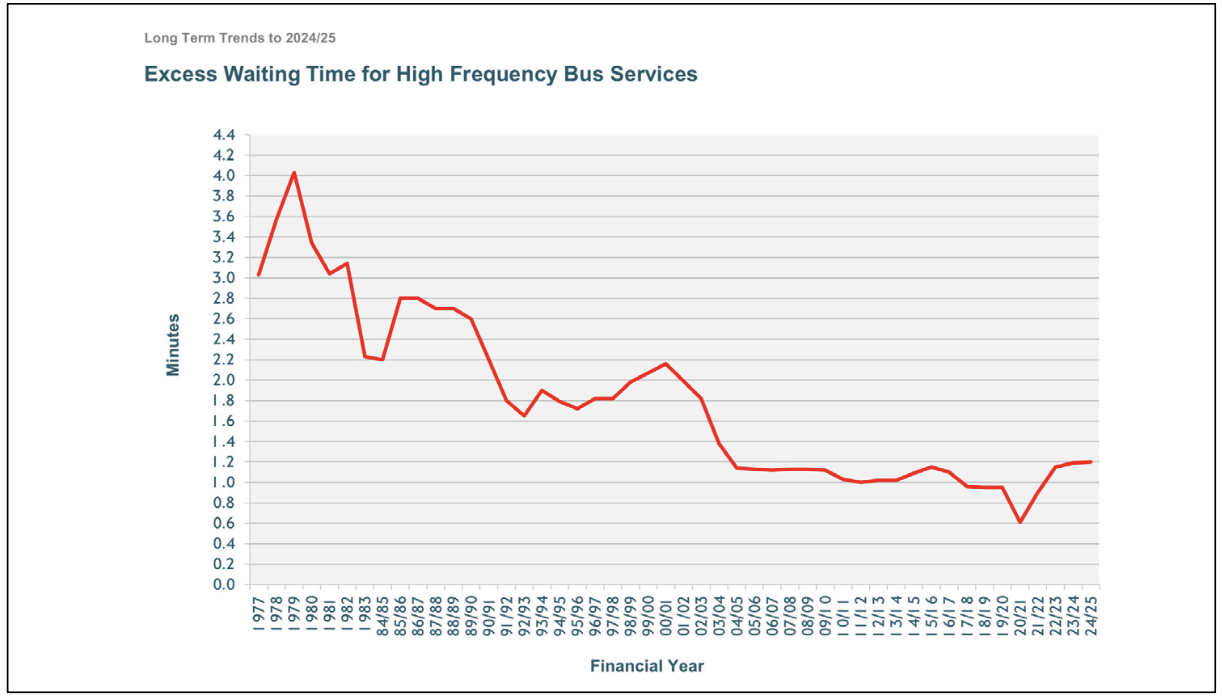
After improving for half a century, bus service unreliability has been rising
Primary amongst the other measures was the London Bus Initiative which introduced over 200 bus priority lanes across London between 2000 and 2008 and, crucially, enforced them with cameras. Oyster ticketing meanwhile reduced boarding times. And, of course, congestion charging was the most effective area-wide bus priority. The funding from congestion charging was directed towards new and better services.
The improvement in bus reliability was dramatic and this was a golden era for bus passengers with improved reliability, more frequent buses, more routes and route extensions. Passenger levels rose rapidly to 6.5 million journeys a day.
But, in 2008, new Mayor Boris Johnson was elected promising to ‘keep the traffic moving’. Proposals oscillated between road tunnels from Johnson himself and roads pricing from the ‘Roads Taskforce’ he established. Neither of these proposals were implemented.
What did happen, however, was the abandonment of a second round of bus priority and a second new contract regime to incentivise quality of service. Johnson’s favoured mode for improvement was instead cycling, and though he later revealed a passion for making buses out of cardboard wine boxes, real buses were subject to neglect.
There was a pathetic cosmetic PR attempt to give cyclists their own blue painted cycle lanes, and the extended West London congestion zone was meanwhile removed. Johnson also got to remove the supposedly ‘dangerous’ bendybuses and introduce instead the ‘New Routemaster Bus for London’, now no longer a particularly passenger- friendly vehicle with the conductors gone and the rear doors kept shut. There was an unabated rise of white vans and Ubers.
In Johnson’s second term from 2012 he appointed journalist and fanatical cyclist, Andrew Gilligan, as his Cycling Czar. The single focus of London streets policy dramatically turned from tackling congestion and London’s most important passenger service, the bus, to London’s smallest private mode, the bicycle.
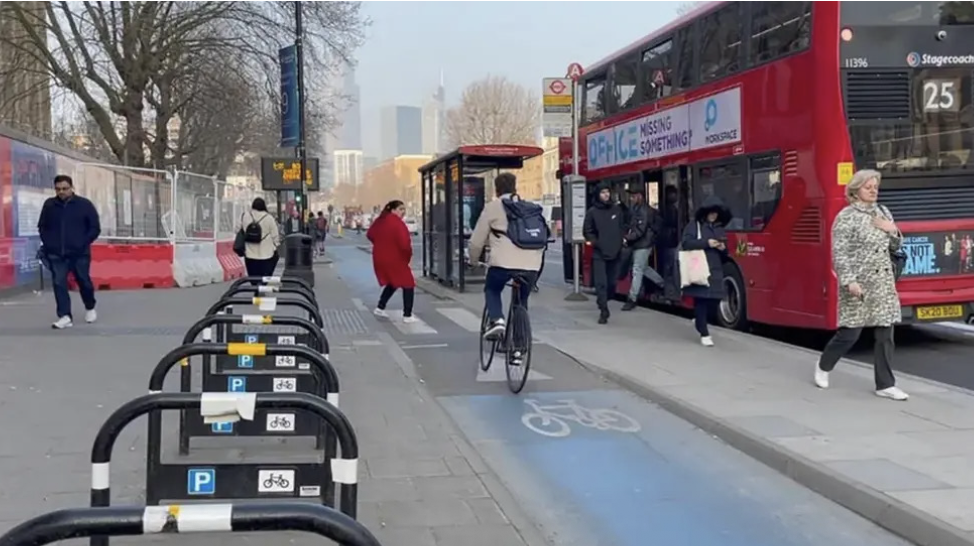
‘Floating bus stops’ put passengers at risk of conflict with cyclists
Cycle Superhighways and mini-Hollands consumed much of TfL’s energy and eye watering sums of money for the next four years. Bus lanes were converted to cycle tracks and motor vehicle capacity reduced in favour of cycle priority, with bus passengers disadvantaged and put at risk by having to cross the lanes used by speeding cyclists to reach so-called ‘floating bus stops’ separated from the pavement.
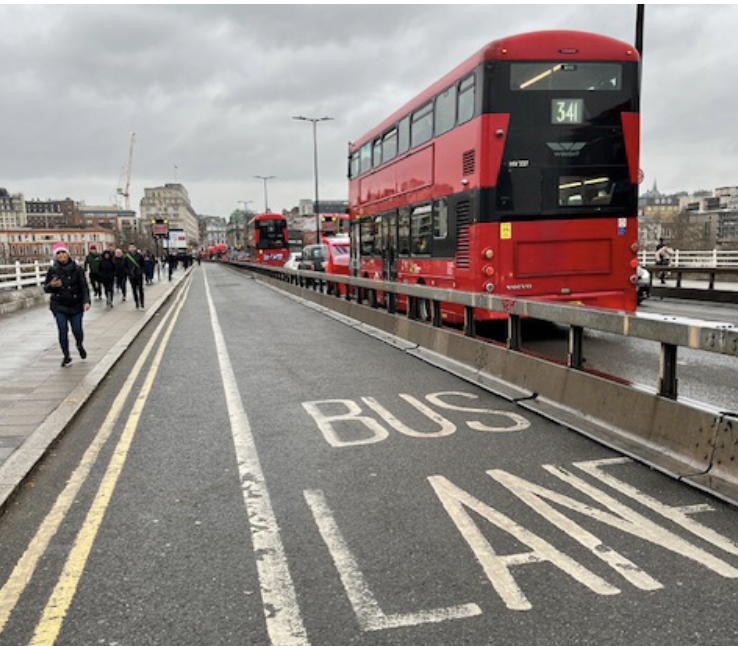
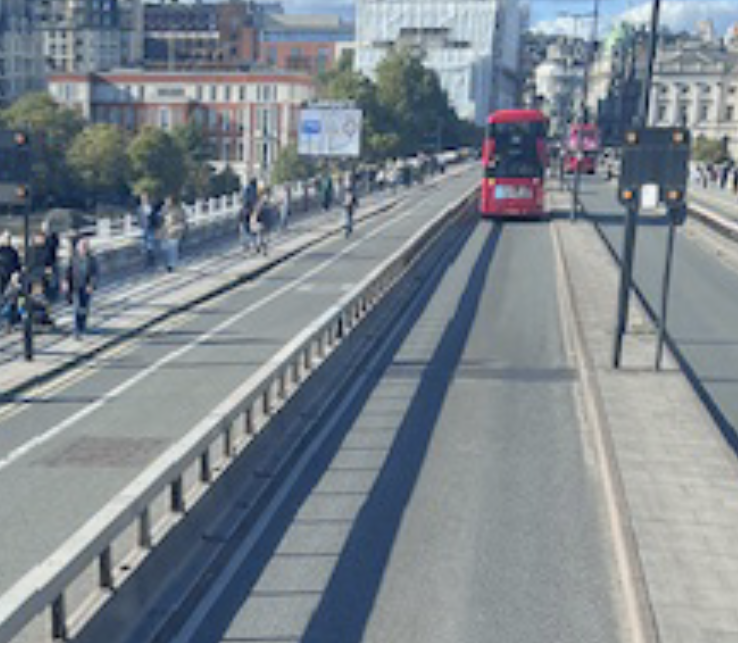
On London’s Waterloo Bridge, a former bus lane with a cycle section alongside was turned into a segregated cycle superhighway with buses given less space amongst general traffic. The pictures show the situation after the bus lane was decommissioned (left) and the new situation (right)
With massive amounts of disruption due to road works and constant property development and demolitions and re-development activity, plus the loss of bus lanes and major loss of motor vehicle capacity at key junctions across inner London, the inevitable occurred. Bus journey times peaked and then slowed dramatically from around 2013/14.
TfL and the bus operators did their bit over the years to maintain performance by adjusting traffic lights to favour buses, shortening bus routes and improving their control of services. TfL officers undertook a lot of work to establish that the decline in passenger numbers was linked to slower bus speeds. But the message was unwelcome, and thus unheard or ignored internally.
Mayor Khan’s mayoralty from 2018 carried on where Mayor Johnson’s left off in respect of streets policy. A new Cycling Czar adopted Gilligan’s single focus on bicycles. This time under the cover of ‘a healthy streets agenda’. The low point as revealed by the bus use data was probably hit just before COVID struck in early 2019 and put everything into deep freeze. Sadly, not a lot has been changing for the better in the post-pandemic period.
MOVING AND WAITING
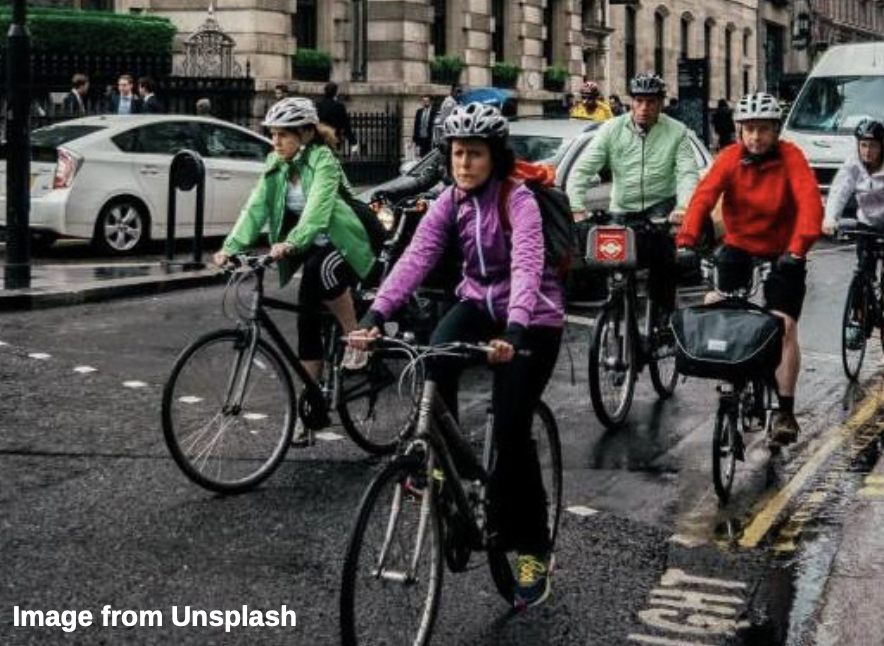
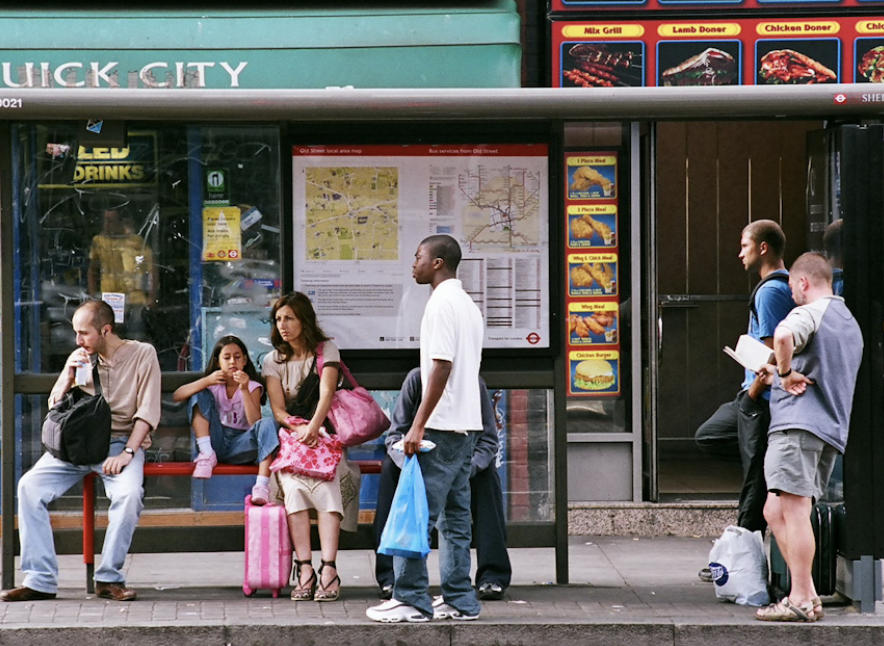
Transport users in London on bikes are generally able to keep moving by responding to best available journey options, whereas bus passengers are at the mercy of only travelling when their mode turns up – and sometimes their mode is frustratingly unreliable. Documenting their experience was part of a creative photographic essay by Richard Hooker (see rzhooker.com/By-the-Bus-Stop)
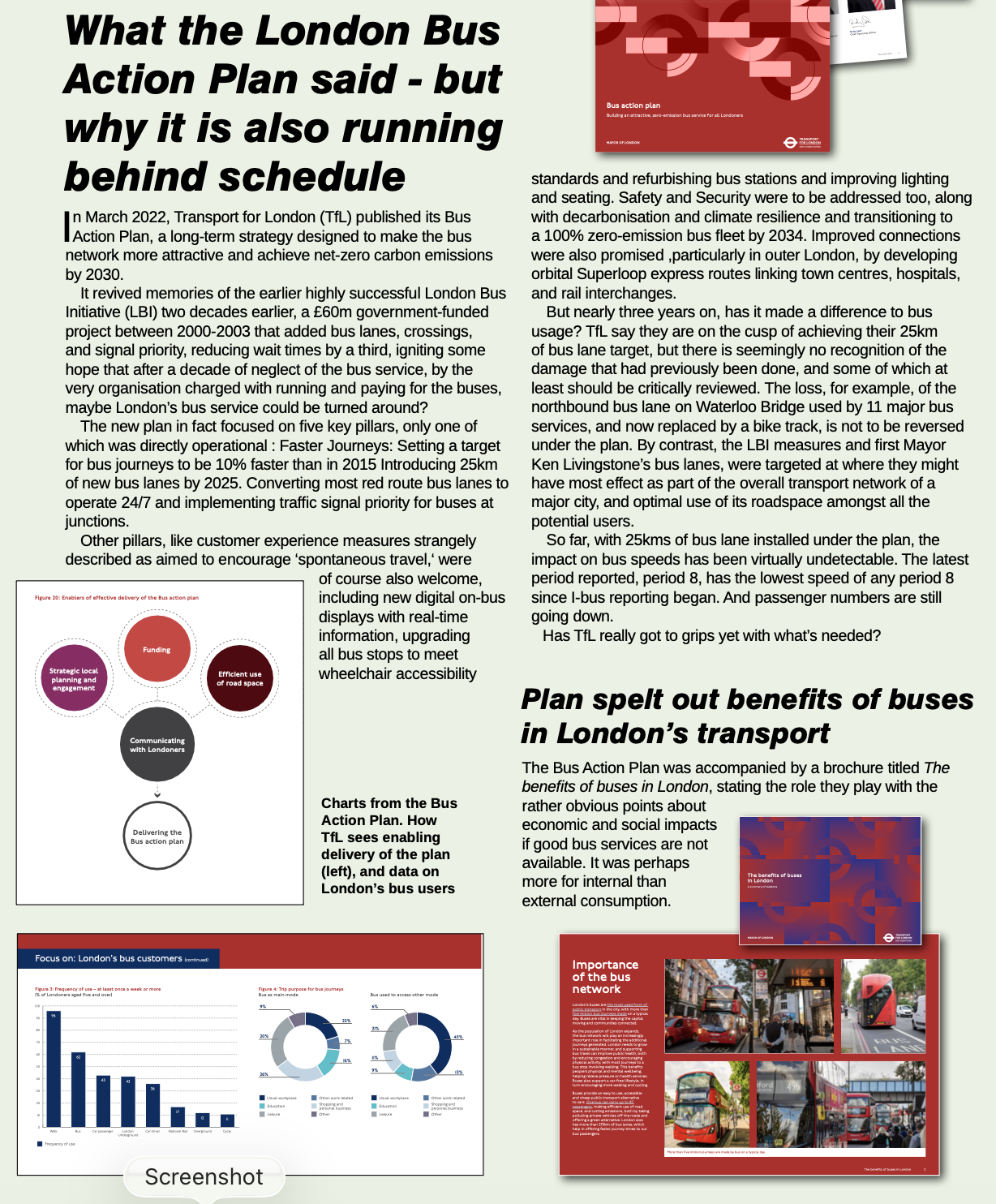
Well, there is indeed a Bus Action plan that was published in March 2022, https://content.tfl.gov.uk/bus-action-plan.pdf promising to adjust traffic signal timings, add bus lanes and increase the hours of operation. The plan was accompanied by a brochure titled The benefits of buses in London, stating the rather obvious, and perhaps more for internal than external consumption (https://content.tfl.gov.uk/the-economic-and-social-benefits-of-buses.pdf).
There has latterly been at least some recognition of the damage that has been done to the bus service - hence the poster. Concerns about floating bus stops are being acknowledged, if not remedied. The new Bus Services Bill passed through its parliamentary phases with ex- Deputy Mayor of London, now Transport Secretary, Heidi Alexander MP, required to produce guidance on floating bus stops.
Through the scrutiny of the bill we found a British Standard BS8300 -1, had been published in 2018 requiring that passengers should not have to cross a cycle track to get to access the stop! DfT have acknowledged this, but appear to be simply setting it aside - ignoring it in favour of largely unproven cycle safety benefits.
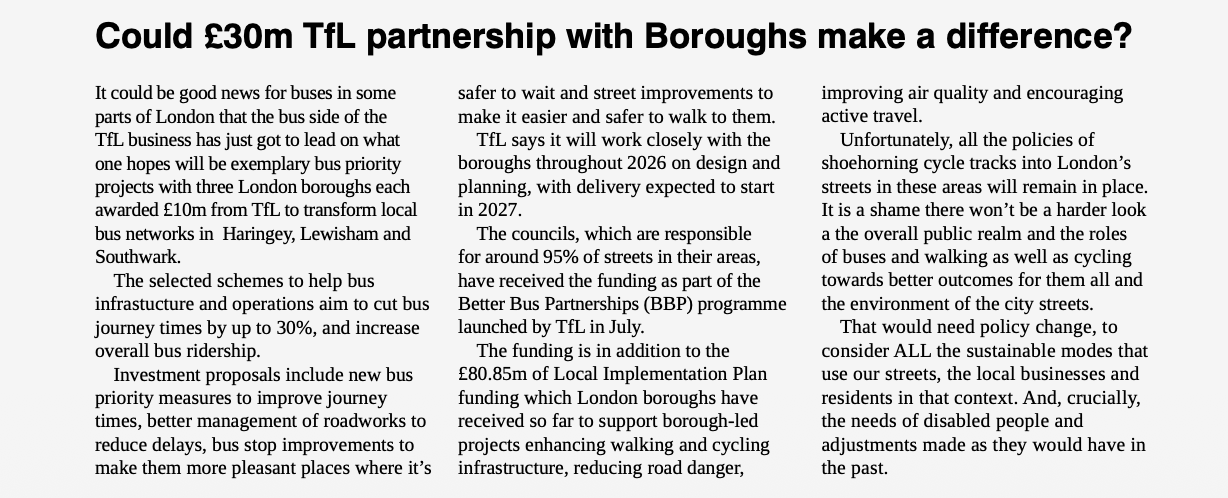
One bright spot in the London bus scene is the Superloop. A limited stop bus system brought in since 2023 to complement the normal bus network and provide faster inter-suburban orbital and radial services, including the Bakerloop extension to the Bakerloo Underground line started this year. Though this development comes at a high cost.
But there are inherent contradictions. Part of TfL is putting in bus lanes and other bus priority measures, while another part is taking out bus priority and removing motor vehicle capacity from bus routes and making buses fight for their bit of it, often used in favour of cyclists.
Sadly, bus service performance remains the worst it has been since Livingstone’s first term. Reliability is worsening as shown in the chart. Bus speeds are the worst they have since the reporting mechanisms of TfL’s I-bus system in 2013. TfL have missed their ‘bus journey time’ target for the last three years despite slackening that target, and passengers have voted with their feet – literally, often, by walking instead of catching an unreliable and slow-moving bus. That of course adds to TfL’s financial problems too. The time savings by taking the tube for longer journeys are meanwhile huge versus a slow moving bus.
NOT ON THE SAME LANE ANYMORE?
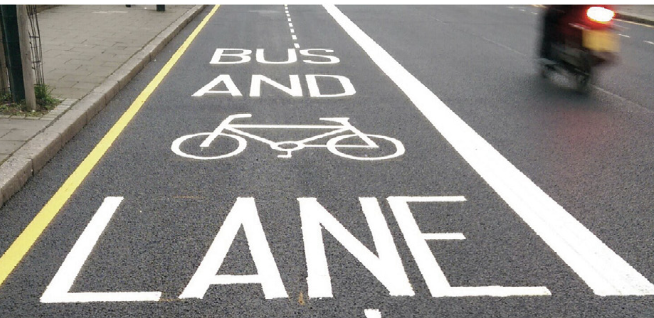
Buses and bikes have shared dedicated road space in the past, but now seem to be in competition for it
It’s a vicious circle. As bus speeds fall, operating costs rise (because the costs of buses and drivers are mainly hourly), and ridership falls. The subsidy in 2014 was £547m (23p per trip). By 2023 it was £786m (45p per trip). That’s an increase of around 95%. And future costs could climb significantly too, as competition in bidding for London Bus contracts looks increasingly weak so that will likely push up tender prices when contracts expire. TfL are looking at a £1Billion subsidy in 2025!
Andy Lord, TfL Transport Commissioner, has recently been reported telling the London Assembly budget committee “We have to increase ridership. If we don’t do anything the cost of the bus operation is going to grow significantly over the next four years, to the point that it will be unsustainable and we will have to reduce it.”
Critics meanwhile say TfL (and the Mayor) seem to no longer have any clear idea who buses are for, as the current policy appears to disadvantage low income workers, or the disabled and elderly, who don’t cycle, so that so-called ‘Lycra Louts’ employed in very well paid jobs in Central London can race back home to the upmarket inner suburbs while the buses stand in traffic. This is a strange policy for allocating scarce roadspace – especially from a Labour mayor.
As I was completing this article, controversy over the causes of decline in bus use in London was actually heightened further by the admission of former London Transport Commissioner, and now Labour Transport Minister Lord Hendy, that introduction of extensive new dedicated facilities for cyclists has damaged bus reliability.
The admission comes as TfL’s latest annual data report for 2024/25 shows that bus demand was estimated at 1,842 million journeys, a 1.5% decrease from 2023/24, and continuing the recent declining trend. Bus journeys in 2024/25 were estimated to be 22.8% lower than the high point in 2014/15.
So what of the actions that poster describes to ‘make your journey brighter’? “We’re upgrading traffic signalling, as well as extending some bus lanes and increasing the hours they operate.”
Well, there is indeed that Bus Action Plan that was published in March 2022, promising to adjust traffic signal timings, add bus lanes and increase the hours of operation.
These are good things to be doing, but it should be noted their 25Kms of bus lane has been largely installed, yet period 8 of 2025 reports the worst period 8 since records began. The root of the problem is that whilst there may be policies intended to support buses, London government has been, and continues to be, far too casual with the practical performance of London’s bus services. The scale of activity to turn around the decline in bus services is woefully inadequate. There is neither policy, nor commitment to do more.
Realistically, journeys aren’t likely ‘to get brighter’ anytime soon!
References and Links
Vincent Stops worked for 20 years as the Streets Officer at London TravelWatch, the statutory body representing transport users in London. He was also a councillor and some time lead member for transport at the London Borough Hackney, where more residents commute by cycle than drive.
This article was first published in LTT magazine, LTT928, 18 December 2025.
You are currently viewing this page as TAPAS Taster user.
To read and make comments on this article you need to register for free as TAPAS Select user and log in.

Log in
