TAPAS.network | 4 February 2026 | Commentary | Vincent Stops
Key Floating Bus Stop issues still not resolved in the new DfT guidance
thinks the new guidance on floating bus stops is not firm enough on the balance of interest between different road users. But he hopes that local authorities will now at least think harder about their chosen approaches – particularly in London
SO IT IS FINALLY OUT: The DfT published their required guidance on ‘floating bus stops’ on the last day possible, given the legal 3 month deadline set by the Bus Services Act[1].
The guidance is clearly centred around the demands of cycle campaigners, justified in large part by the perception, (not the reality) of their road safety more than that of bus users, and those representing blind, older and other disabled people. It allows the retention of the ‘most problematic’ design of bus stops, and crucially, does not include an equalities assessment.
The controversy was largely created in London, and that is where the most intractable problems seem likely to remain. TfL’s detailed reaction to the new document in terms of practice will thus be the one to watch.
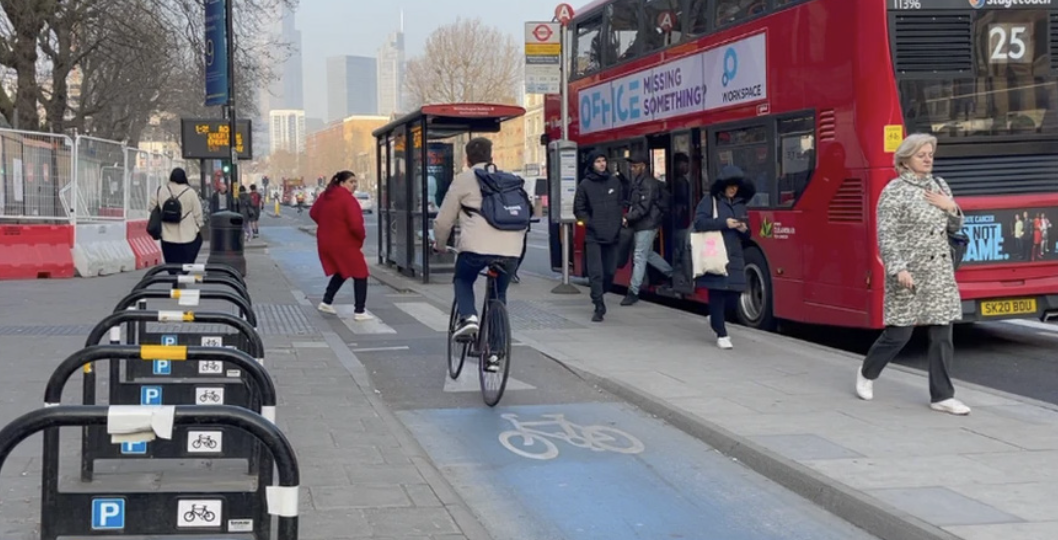
Floating bus stops have been widely installed in London where new cycle lanes have been introduced. They mean potential conflicts between bike riders and pedestrians.
Critics of the current arrangements in both the Commons and the Lords sought to get the position addressed during passage of the recent Bus Services legislation. The government resisted amendments to the Bill, but at the second reading, in response to registered blind MP Marsha De Cordova, the Secretary of State said:
“We will be looking carefully at this issue. I am very conscious of the needs of the visually impaired community, but I am also very conscious of the need to protect cyclists and pedestrians on our roads, so I am keen for us to look at the issue in the round.”
The Minister for Roads Simon Lightwood then wrote to all local authorities in England asking them to pause the installation of floating bus stop designs which require passengers to board or alight directly from or into a cycle track. This pause is still in place.
New guidance was promised to follow enactment of the legislation. In hindsight, Heidi Alexander’s response made it clear that the so-called ‘needs’ of cyclists and cycling would take precedence in the design of bus stops and the real needs that blind people have, and which enable them to use the bus independently, would continue to be effectively ignored.
One striking aspect of the guidance is that a big part of the justification for floating bus stops is the ‘perception of safety’ for cyclists.
This is mentioned twice:
“Not only must cycle infrastructure be safe, it should also be perceived to be safe so that more people feel able to cycle.”
“…protected infrastructure is an important tool to keep cyclists safe, as well as improve the perception of how safe it is to cycle…”
Alongside this emphasis on perception, is the absence of any substantive evidence that there is an actual road safety benefit to those who cycle compared with the real problems posed to those on the footpath, boarding or alighting from buses, or just seeking to cross the road.
Throughout the guidance the assumption is made that segregated lanes simply equate to ‘safe cycling’ and that the necessity of having floating bus stops is somehow integral to that. Both assumptions are open to challenge.
Firstly, we know that 80% of collisions that injure cyclists occur at highway intersections and aren’t associated with bus stops. London, which has the most segregated infrastructure for cycling, is seeing rising numbers of serious cyclist injuries and injuries per journey2.
The second assumption that seems to be being made is that cycling is only attractive if the track for bikes is completely continuous, and that cyclists should not be required to stop and wait behind buses for passengers to board from the pavement.
This assumption is particularly peculiar. From the time the cycle tracks (and floating bus stops with the associated bus stop islands) were introduced in London, it has been known that bus passengers have difficulty crossing the cycle lane to get to the bus stop.
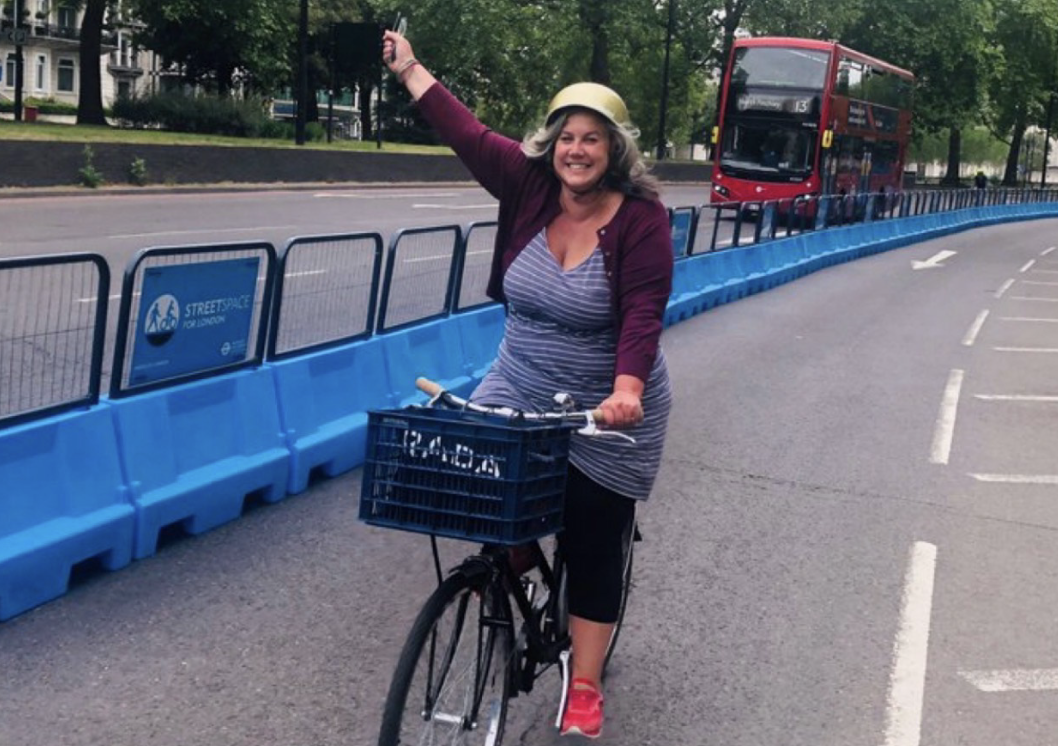
In a previous life, Transport Secretary Heidi Alexander was the London Mayor’s advisor on Transport. In that role she pushed forward extensive dedicated cycle infrastructure including this new allocation of road space on Park Lane.
The very introduction of zebra crossings across cycle tracks, and associated safety warning to bus passengers, is a recognition of that fact. Would it really be a deterrent to cycling to require cyclists to pause, instead, at a stop line behind a bus stop, for as long as it takes passengers to board from the pavement, without having to cross a cycle track?
After all, everyone else traveling in cities is required to occasionally wait. Free flow conditions for even pedestrians are rarely found.
The new guidance simply accepts the status quo on the need for the current arrangements,but promotes a ‘gold standard’ design with a ‘desired’ island width of 3.5m and ‘desired’, cycle track of 2m, delineated by ‘desired’ 125mm kerbs. Plus an ‘optional activated sign’ for those on foot to stop the bikes whilst they cross.
Such features do not presently all exist in any floating bus stop example I know, nor are likely to!
Meanwhile, the guidance allows pretty much anything else we have seen on our streets to continue following a ‘design assessment’.
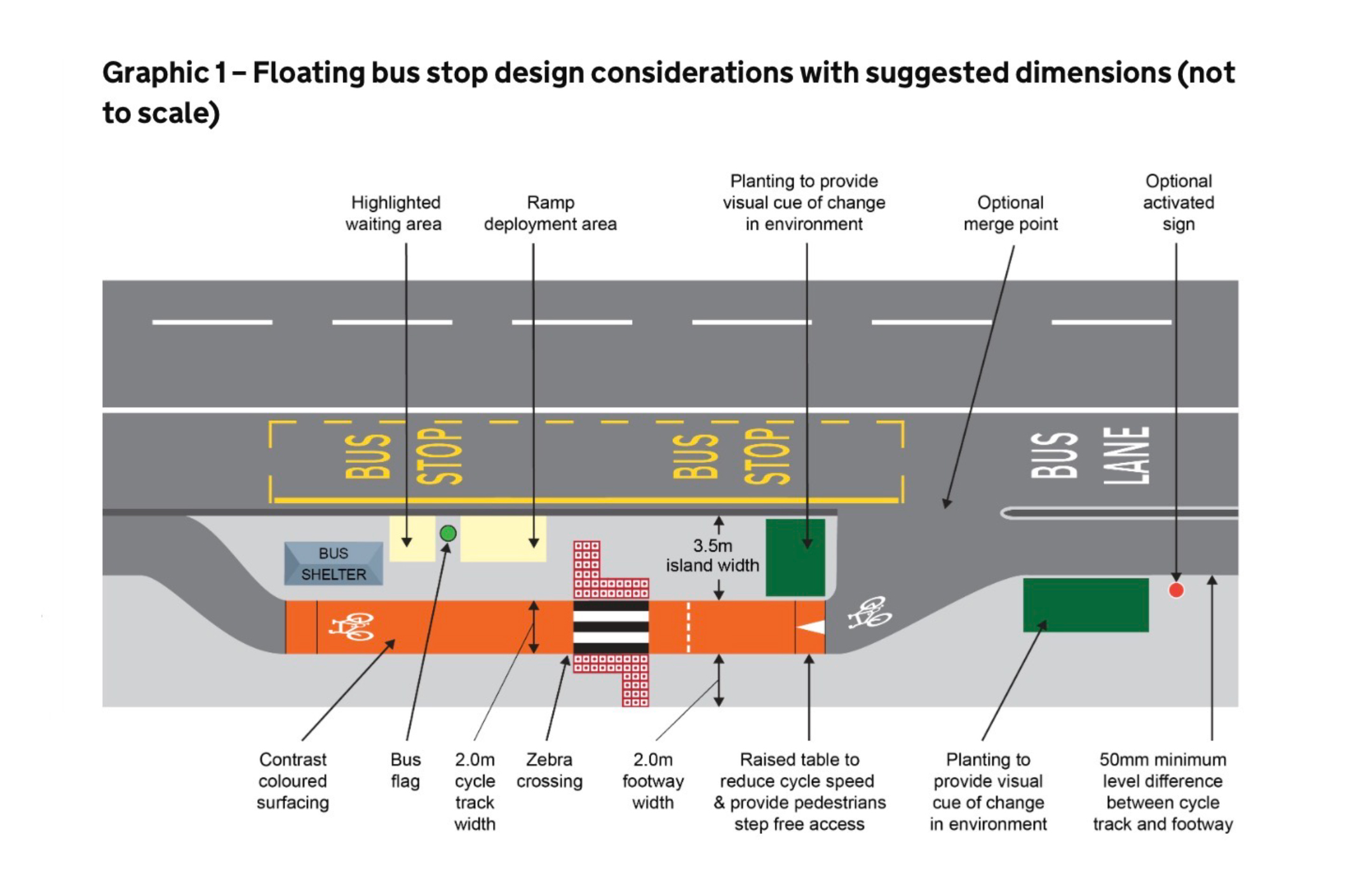
Three types of highway treatment where there are cycle lanes passing bus stops are featured in the guidance. One is the ‘idealised’ version where there is sufficient space (though not everyone believes even that is acceptable for pedestrians) and the other two are compromises of various kinds, with one that interrupts the cycle lane to allow buses to reach the kerb (see illustrations).
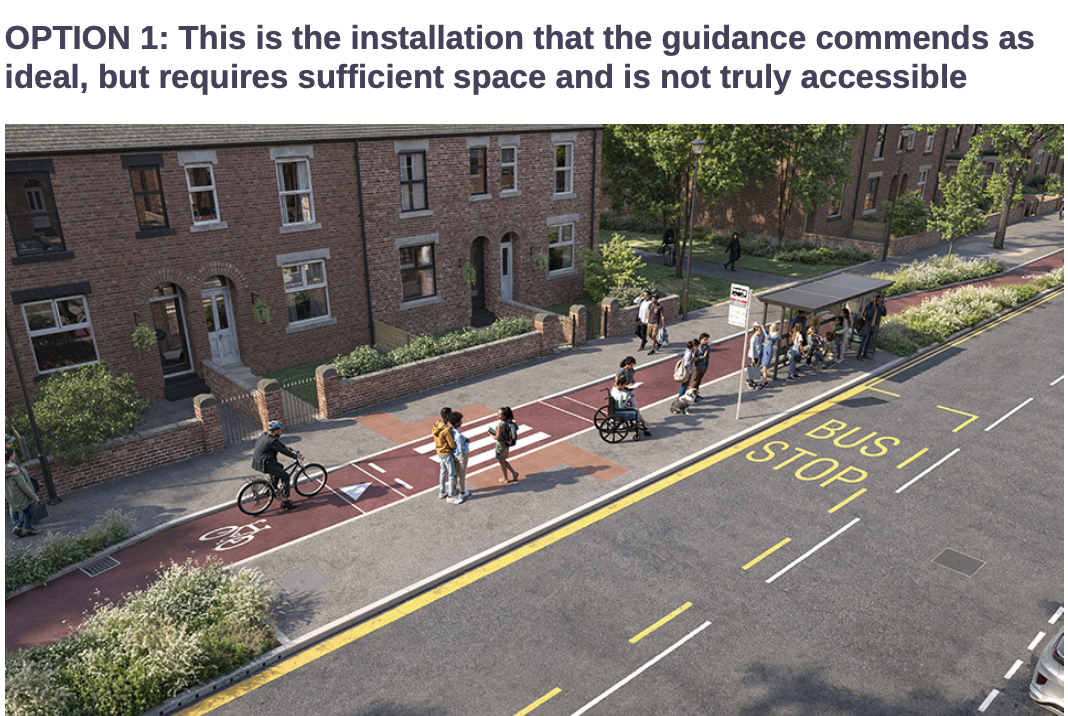
This graphic from the guidance shows a layout for an ‘ideal’ bus stop bypass. This layout can be adapted for sites with more than one bus, or to accommodate a two-way cycle track. The island width is 3.5m ideally, but 2.5m minimum, and the footway width 2m desired, 1.5m minimum, the same for the cycle track itself if one-way. If two-ways, the cycle track ideal width is given as 3m, or 2.5m as minimum. There is a zebra crossing and tactile paving.
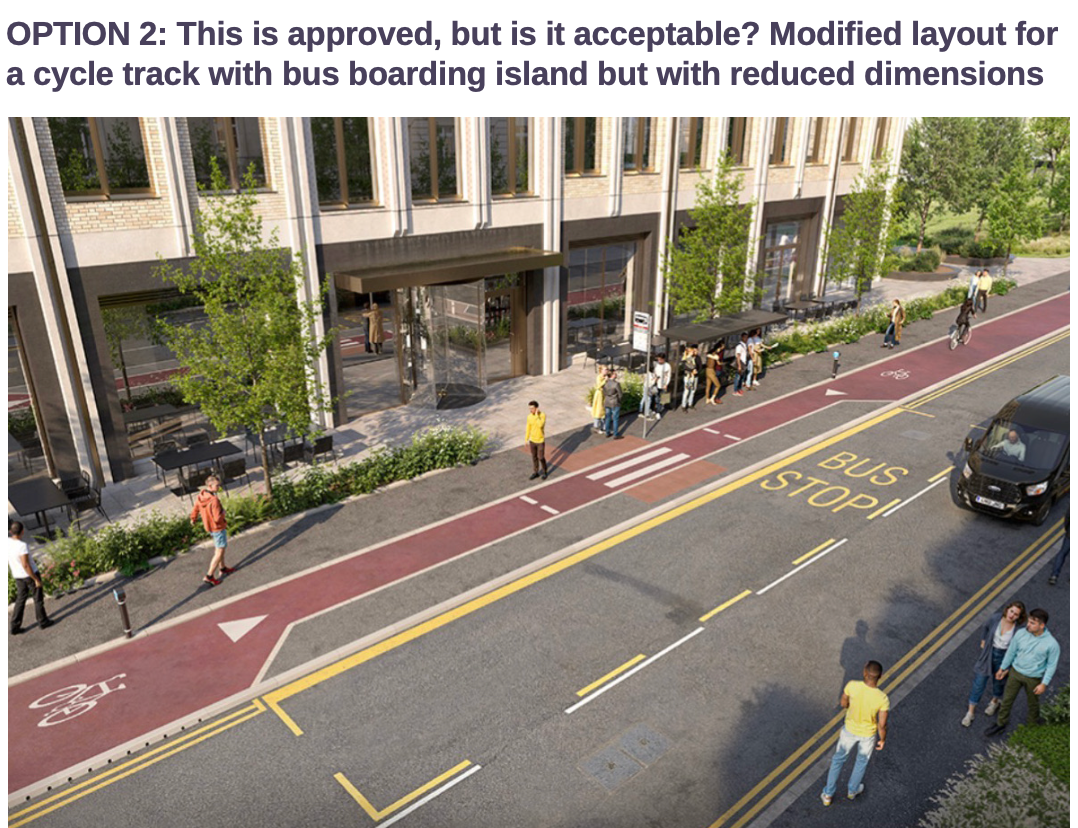
The guidance introduces and approves a third type of design. The authors call it a ‘Cycle track with bus boarding island’. It’s a modification of the SUBB, but with a boarding island adjacent to the kerb. There are some examples in London and it is likely to prove However, it is probable that some authorities will implement floating bus stops and some will not. highly controversial. This design ignores even the research the authors choose to refer to There are emerging examples on-street of the final example illustrated in the guidance. A bus stop undertaken by Living Streets, and that commissioned by Guide Dogs. The design describes that is accessible to all. I do hope many do. a boarding island of 1.5m, far below the 3.5m recommended by University College London, and no kerb, a red line for the Guide Dogs charity!
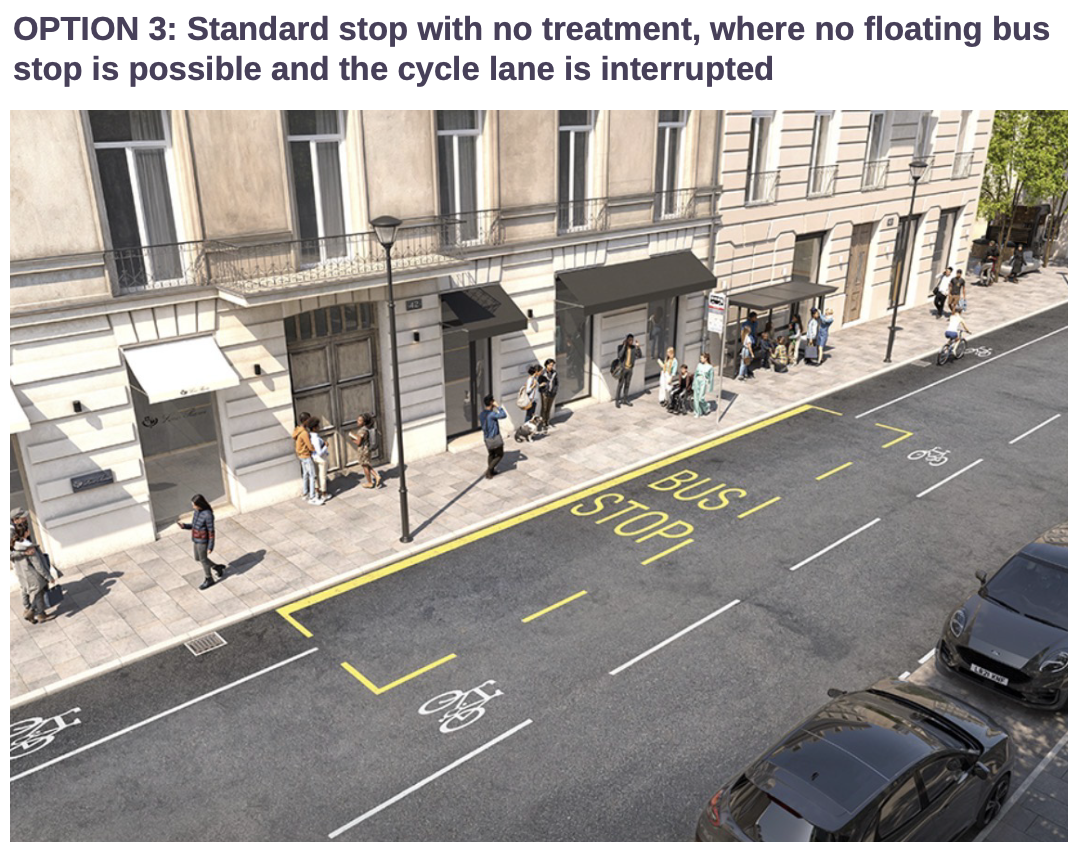
Bus stops may be left untreated where cyclist flows and traffic speeds and volumes are low and where the risk to cyclist safety is low, says the guidance. This may be preferable where, after considering the outcome of the assessment process, it is clear that a floating bus stop is not suitable for a particular location.
The DfT says “this guidance should be used to adjust proposed designs which would fall within the pause. Where these designs are already installed, this guidance can be used to make adjustments to them, but it is for local authorities to determine how to apply it to their networks.”
My reading of this is that highway authorities now get on review those Shared Use Bus Boarders they have, but they cannot be forced to change them along the lines they suggest.
SUBBs can, and I am sure will, be retained following this mild request from the guidance to simply review their format. See section entitled ‘Shared use bus boarders’:
“The assessment process should be used to review existing sites to establish the user profile and available space, and the results used to consider what changes should be made.
A review may conclude that no changes are needed, taking into account factors such as performance and user feedback.”
And finally, despite all the current controversy about equalities and the recognition of everyone’s, human rights etc., no equality impact assessment has been undertaken in the guidance, nor help in judging the balance of advantage.
This problem is all handed down to local authorities, whom it is suggested should undertake such an assessment. And, of course, we know the outcome of these to date has invariably been to set aside the fact that stops are inaccessible to all.
Euphemisms, such as ‘challenging to blind people’ and ‘balancing the needs of other equality groups need to cycle’ simply replace the use of the word ‘inaccessible’.
Going forward, it seems likely that some authorities will continue to implement floating bus stops whilst more may think twice and will not.
In the right circumstances, and with careful thought about the detailed design, there are some emerging examples on-street of bus stops on bike lanes that are genuinely accessible to all, as the final example illustrated in the guidance represents.
I do hope to see many authorities following that path.
References and Links
-
Cyclist injuries and injuries per journey https://tinyurl.com/bdb32wmj
-
Link to guidance document
https://www.gov.uk/government/publications/floating-bus-stops-provision-and-design/floating-bus-stops-provision-and-design
Vincent Stops worked for 20 years as the Streets Officer at London TravelWatch, the statutory body representing transport users in London. He was also a councillor and some time lead member for transport at the London Borough Hackney, where more residents commute by cycle than drive.
This article was first published in LTT magazine, LTT931, 4 February 2026.
You are currently viewing this page as TAPAS Taster user.
To read and make comments on this article you need to register for free as TAPAS Select user and log in.

Log in
