TAPAS.network | 3 December 2025 | Commentary | John Dales
My Counsel for Councils - campaign collectively to help us better appreciate the important work you do!

once again found a presentation at the Local Transport Summit that piqued his attention and concern: the reputation of local government and the recognition of its vital role
THE 17TH CENTURY French mathematician-philosopher-theologian Blaise Pascal is often credited with coining the phrase, ‘to understand is to forgive’, and that idea is behind what follows.
These observations were prompted by one of the many fascinating presentations at this year’s Local Transport Summit. This fine event, which this year took place in Derby, is always something I look forward to enormously, not least for the lines of thoughts it invariably triggers or reawakens.
Let me lead you into the specific line of thought I’m writing about here by offering an anecdote containing an analogy.
When I was young lad, my Mum used to take me and my two siblings, every month or so, to visit a couple of maiden aunts. We’d play games while Mum talked with Aunty Nell and Aunty Jen, and we’d occasionally chip in ourselves. There’d be sandwiches, cakes, scones and squash for tea, and always loads to go round.
We were reasonably well-behaved and very good at performing our roles of bringing joyful noise, youthful life and healthy appetites into a home where these things were uncommon. Plus, Mum would help keep them in touch with aspects of the outside world with which they were unfamiliar, but fascinated. Thus, our occasional visits were, for the Aunties, a treat.
From time to time, a slightly sour note nevertheless intruded on our happy gatherings: the Aunties’ complaints about (Mum’s) Cousin Adline. She was the one who did most of their shopping, met many of their other regular needs, and generally was on hand to help when needed. But, although Adline did all the important, routine work for them, what the sisters seemed to notice most was when her faithful service failed – not all the times it went like clockwork, to their benefit.
So, what is the analogy I see in this, you may reasonably ask? Well, it’s that the Aunties’ view of Cousin Adline seems to me like most people’s view of ‘the Council’.
Your local Council; others’ local Councils; and local Councils up and down the land. The bodies at whose very mention the eyes of most citizens often involuntarily start to roll, even if they voted for those running it. The Council which may have its faults, but which very definitely plays a vital role in most peoples’ lives, arguably no more so that in respect of transport.
The Council which is, of course imperfect, and which inevitably will make mistakes. The Council that cannot possibly please everyone with each act or decision made. The Council which is, after all, but a collection of many individuals and systems that inevitably sometimes fail to align or communicate as would be ideal.
The Council which does many good and necessary things for us that we don’t so much ignore, as just take utterly for granted. The same Council which, when it displeases us, for whatever reason, we too readily pillory with too little reason, and almost no understanding. The Council which, proving Pascal’s dictum, we are therefore rarely willing to forgive.
This, at least, is the fruit of my reflections on the vexed question of why – despite its routine importance and everyday value to almost all of us – local government in this country is generally held in miserably low esteem. Perhaps ‘Exhibit A’ for the truth of the saying that familiarity breeds contempt – just like the fate suffered by Cousin Adline.
I’ve had these reflections before, about the imbalance between the value of local government to the general public and the respect which that public has for it, and they were reawaken by an excellent presentation at the Summit by Louise Reardon. She is Professor of Governance and Public Policy at the University of Birmingham and also, relevantly, the Thematic Research Lead for Transport at the UK Parliament.

Louise Reardon: her insight into how our local democracy is functioning forms the basis of this commentary
Under the title ‘The State of English Local Democracy and Governance’, Louise began her talk seeking to inform her Summit audience about the political context of transport planning – especially with current instability brought by the fragmentation of the old two/three party system. She referred to two key pieces of recent research relating to local government generally, and then went on to look at how the picture is somewhat different when it comes to elected Metro Mayors.
The headline from the Electoral Commission’s report on the May 2025 local elections in England (https://www.electoralcommission.org.uk/research-reports-and-data/our-reports-and-data-past-elections-and-referendums/report-may-2025-local-elections-england) was that the overall turnout was a measly 34%. That means two-thirds of the electorate couldn’t be bothered even to vote. Helpful comparisons include 60% for the 2024 General Election which, though much higher than the local government figure, was the lowest GE turnout since 2001. Other comparators are 72% for the 2016 Brexit Referendum and 37% for the 2019 European Parliament Election.
However measly this 34% figure might seem, and actually be, turnout has been in the 30s for every local election this century so far, other than those when the polling day for local elections was the same as for a General Election, when the turnout more or less doubles.
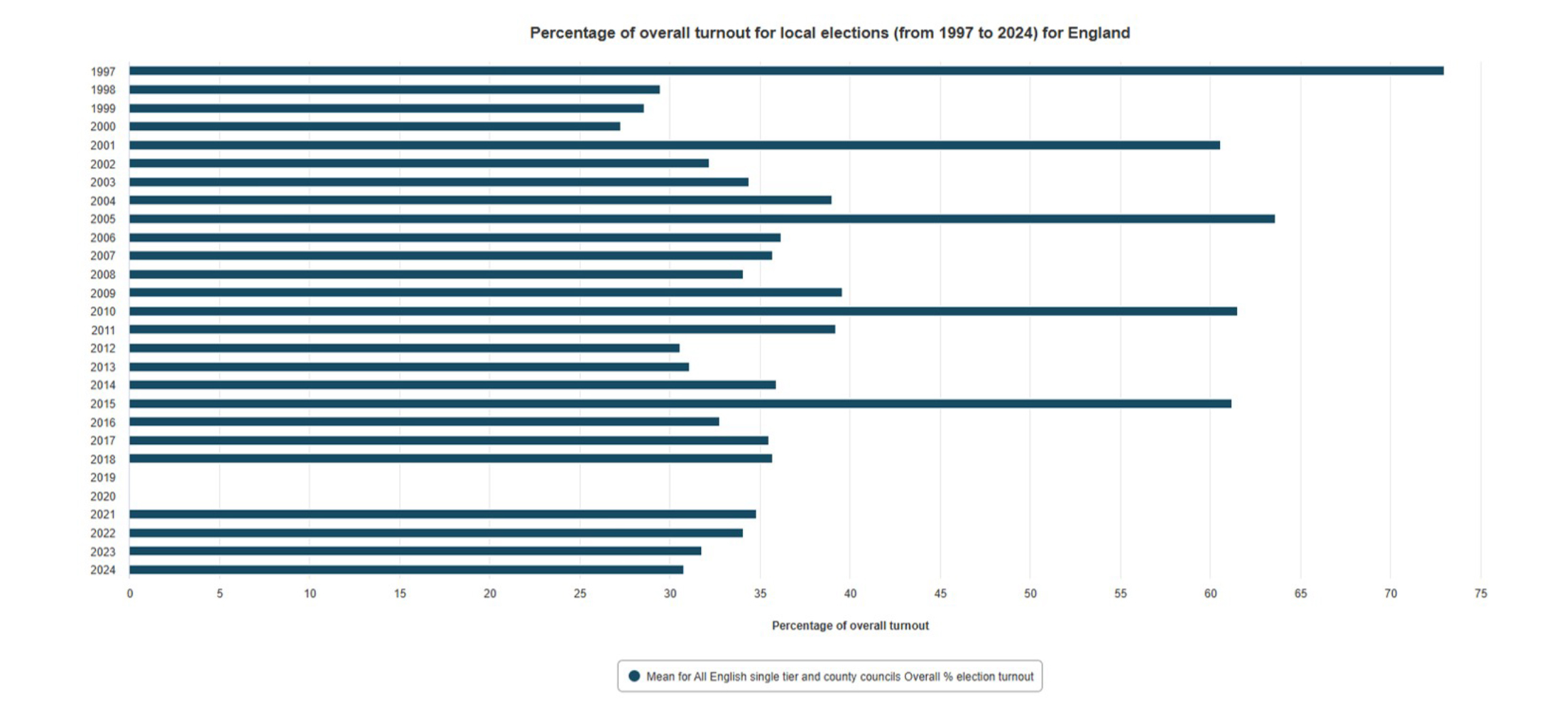
Percentage of overall turnout for local elections (from 1997 to 2024) for England
As to why such a small proportion of people chose/choose to vote in local elections, the top three reasons given in 2025 were: too busy/busy at work (19%); I was away on election day (11%); and I’m not interested in politics/I’m fed up with politics (10%). These findings are consistent with those for previous elections and, I think, can be summarised fairly, if rather crudely, as “I really just couldn’t be arsed”.
I’ve looked for other explanations for low turnouts in local elections but have mostly found plausible assertions rather than data. There seems consensus over the proposition that local elections are considered ‘second order’ affairs that voters simply see as less important (than General Elections).
The Local Government Information Unit (LGIU), in a short website piece on turnout published in April 2024, acknowledges that, “there is an integral myth in society that local elections don’t have as much impact on people’s lives as national elections do, and therefore, many feel that participating in them is not a priority”. The LGIU, unsurprisingly, refutes this belief, saying that it “couldn’t be further from the truth”.
The article goes on to say that “Local elections and local representatives can have a significant impact on people’s day-to-day lives, often these decisions at the local level hold the most direct consequences and impact. This is because local councils and councillors hold authority over a range of critical services and amenities that communities rely on every single day.”
However, while I agree with this statement, it doesn’t address the problem. Saying “They don’t think we’re very important, but they’re wrong – we are!” doesn’t strike me as a great basis for a strategy to get more people to vote. Asking the questions “Why do people think we’re unimportant, and what can we do about that?” would surely be a far more promising starting point. Hold that thought.
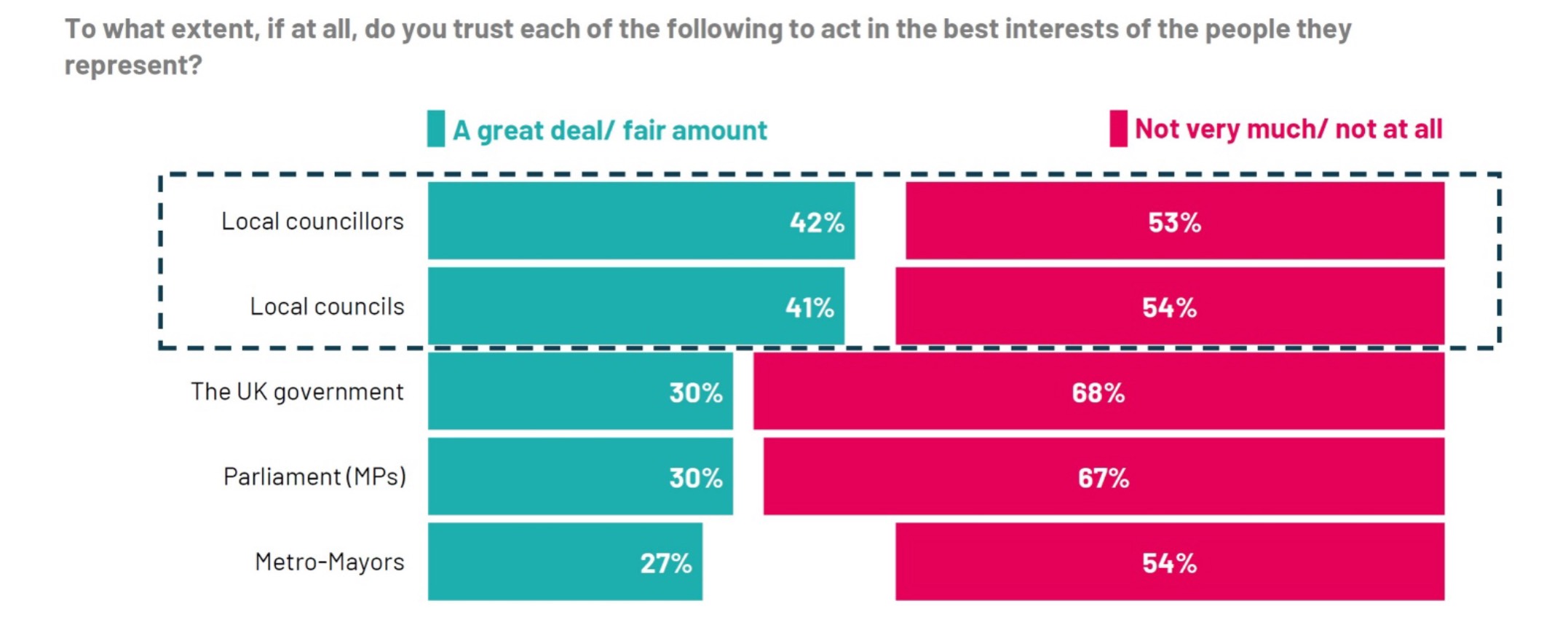
The LGIU is itself the source of the other principal research that Louise Reardon cited, specifically its ‘State of the Locals 2025’ report, prepared with Ipsos. (https://lgiu.org/publication/state-of-the-locals-2025-2/). This revealed that the majority of people (53/54%) do not trust local Councils or councillors to act in the best interests of people in their local area. While this is a lower figure than for the national government (67%), it’s still a dismal state of affairs that only 41/42% of people do think Councils/councillors act on behalf of the people they represent.
Another finding of the research is that only 35% of people say they know something (a ‘great deal’ or a ‘fair amount’) about the work of their local councillors or how decisions are taken by their Council. This, also, is not good.
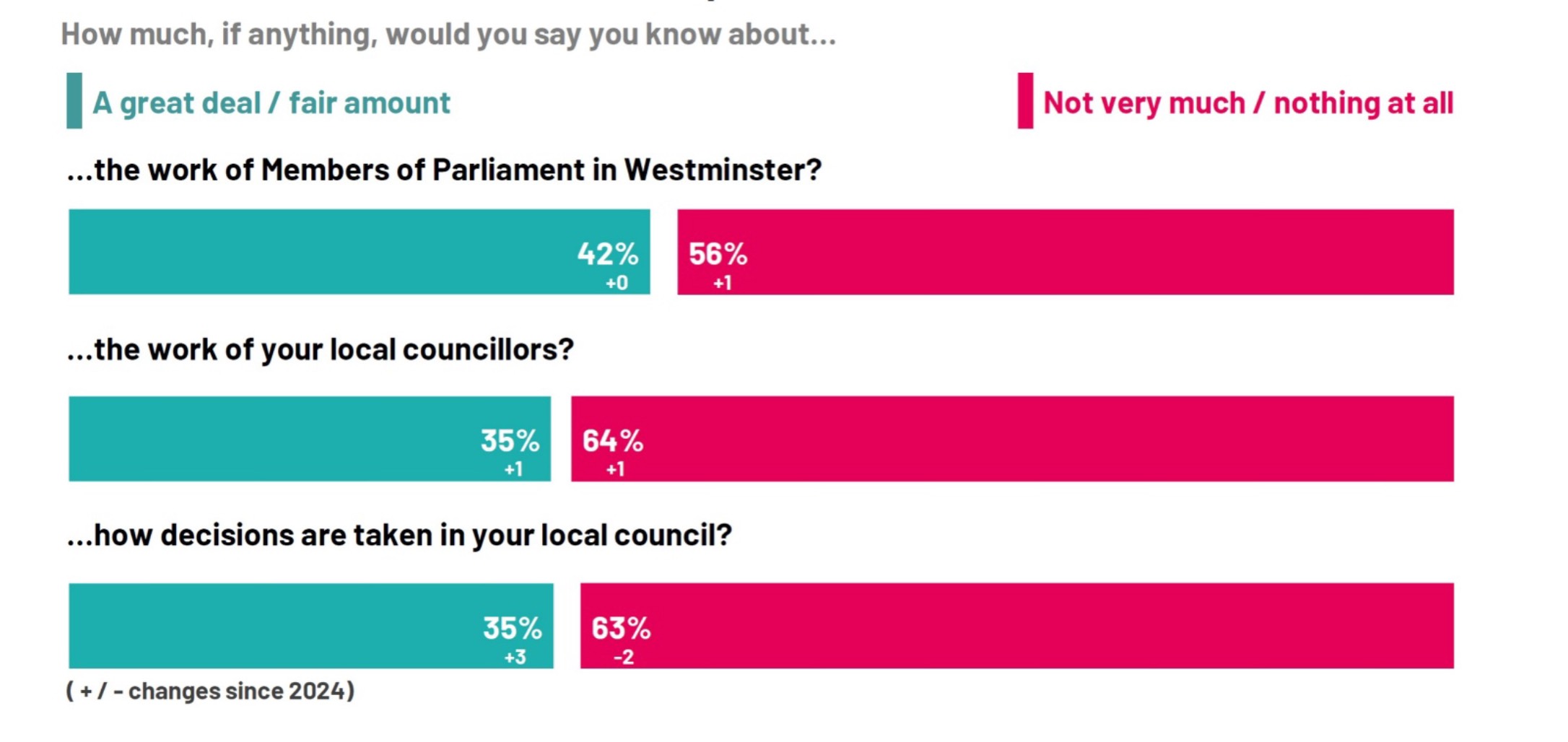
“Most of us don’t trust you and even more of us have no idea what you really do” speaks of an institution that has failed, badly, to connect well with the very people who need it, rely on it, help fund it and should be supportive of it; which is pretty much everyone.
That said, the answers to another question in the LGIU/Ipsos survey paint a slightly more hopeful picture and give something perhaps to build on. Respondents were asked to say which two or three (if any) from a list of people/organisations/agencies they believed have the most impact on a) people’s everyday lives and b) the quality of life in the respondent’s area.
Easily top of the list of the answers to both questions were local Councils, with the role of local councillors themselves believed to have less of an impact. The proportions of respondents who thought Councils and councillors have the most impact on local quality of life (59% and 37%) were appreciably higher than the proportions who thought they have the most impact on the more generic matter of people’s everyday lives (40% and 17%).

These findings also show that the importance of Councils and councillors is rated far greater than that of the national government, with the Prime Minister lagging far behind councillors when it comes to local quality of life (and not that far ahead on everyday lives). This in turn seems to challenge the notion that people turn out for General Elections in greater numbers than for local elections because the former are considered more important (‘first tier’).
Could it be that one of the main reasons turnouts for national elections are much higher than for local elections is the simple fact that General Elections get widespread coverage (i.e. publicity) across most forms of media for weeks leading up to polling day, whereas local elections get comparatively very little?
I’ll come back to that question, but let’s now turn briefly to the 2024 briefing from the Centre for Cities that Louise Reardon referred to in connection with Metro Mayors. Intriguingly entitled Place Over Politics, it covers the results of polling by Focaldata of people living in England’s largest mayoral areas. The headline finding was that Mayors are much more recognisable than other prominent local politicians (the local MP and Council leader), with 88% of people in London being able to name their mayor (Sadiq Khan) and 83% of people in Greater Manchester (Andy Burnham).
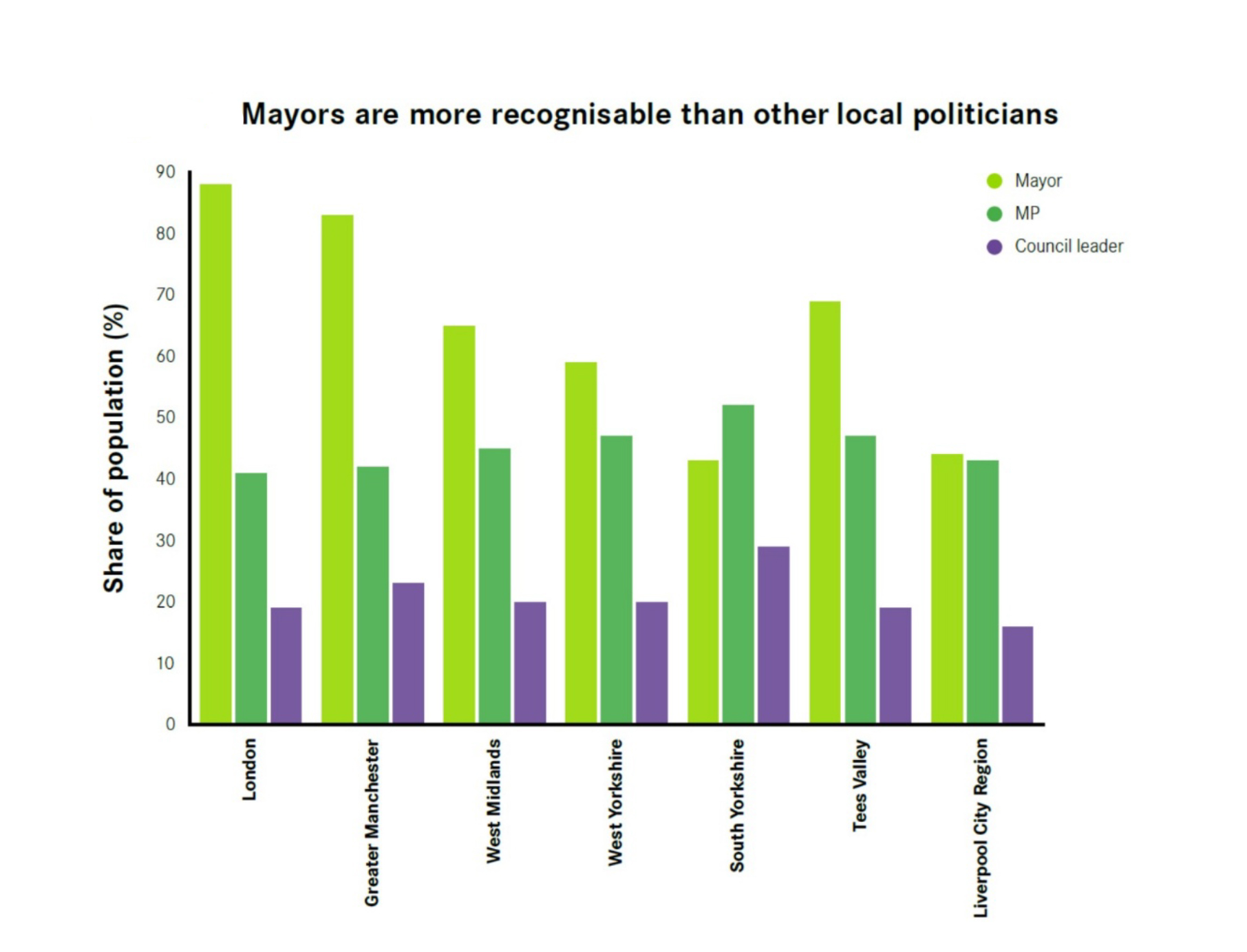
Another interesting discovery was that, whereas around two-thirds of people vote for the party in General Elections and one third for the candidate, this is more or less 50:50 for Metro Mayor elections. This seems likely a reflection of the fact that, as the headline finding revealed, the Mayoral candidates themselves are simply better known than Parliamentary candidates. I would be fascinated to know what these figures are for local elections. From my own experience and anecdata, I would hazard that the ratio is somewhere between the national and Mayoral values and likely nearer the latter.
When it came to the reasons people said they would not vote in the then forthcoming 2024 Mayoral elections, lack of knowledge and distrust towards politicians were the most common factors, and always more influential than disinterest in local politics.
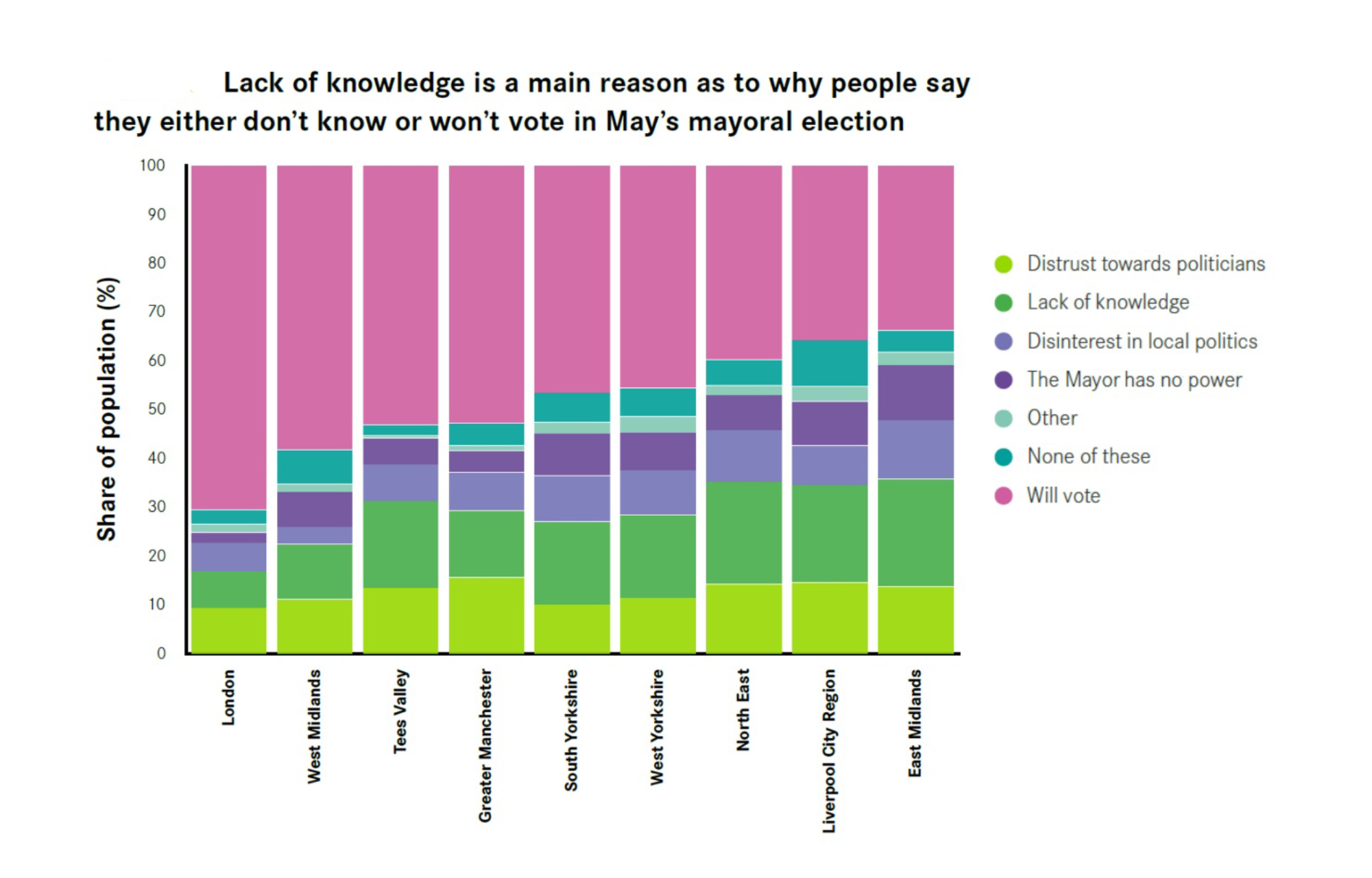
This brings me back to the second graphic presented above, where the LGIU/Ipsos survey showed that an appreciably lower proportion of people trusted Metro Mayors to act in the best interests of the people they represent than they do local Councils (27% against 41%). However, when looking at the proportions of people who did NOT trust, the figure was the same – 54% – for both Mayors and Councils. (This difference between the do trust and don’t trust ratios is explained by the fact that there are a lot more Don’t Knows/Couldn’t Says for Mayors than for Councils).
And now, hoping that all these figures have shone at least some additional light on this topic from the Summit that I have chosen to explore, I’d like to offer some thoughts about what a solution to the Low-Status-and-Regard-for-Councils issue might be. I start with a summary of the starting point.
(a) Turnout in local Council elections is dreadfully low and this should be considered both unacceptable and unhealthy.
(b) Local Councils provide a range of very important services which are routinely undervalued (likely taken for granted), which leads to an unwarranted focus in the popular mind simply on the mistakes Councils make or the things people disagree with.
(c) Local Councils seem unable/unwilling to recognise/diagnose the problem and formulate/implement an effective solution.
(d) There does, nevertheless, seem to be an encouragingly high appreciation amongst the population that Councils do worthwhile and positive things in and for local communities.
(e) It’s plausible to suggest that low turnouts in local elections are less the result of people thinking they’re unimportant than of the fact they attract much less publicity either than General Elections or Metro Mayoral elections where the focus is on specific personalities.
(f) It’s also plausible to suggest that party affiliation is less important to voters in local elections than in General Elections (a suggestion supported by the results of a quick search which say that around 13% of councillors in England are Independents).
(g) Councils, councillors and all politicians have a distrust problem that they must address, in the interests of making our democracy much healthier.
(h) I’ll cheekily add another matter that I’ve not touched on yet, which is that I think more people would vote if they thought their vote would actually count. Many people know, however, that they may as well not bother. That’s because it’s an uncomfortable and not-often-voiced truism that, under the first-past-the-post (FPP) system, every single vote for a candidate that doesn’t win is, for all practical purposes, wasted. This is not helpful in encouraging people to turn out, especially in wards where one party has historically dominated.
Taking all the above together, I strongly believe the case for change – to promote greater turnout – ought to be considered unanswerable. If so, the question arises as to who will lead that change?
My thoughts turned first to the Local Government Association (LGA), a body with a long pedigree and a current membership that comprises 315 of the 317 Councils in England. Surely it is ideally placed to lead the way, no?
But then I thought, “Hang on. The LGA took its present form in 1997, and its existence has therefore covered exactly the same period as that presented in the first (turnout) graphic presented above, during which Council election turnouts have varied somewhere between 30% and 40%, and have more recently declined to the lower end of that range”. So, I concluded, either the LGA doesn’t recognise the problem, or it hasn’t addressed it at all effectively.
Further investigation suggested, however, a more prosaic problem. When I looked at what the LGA says about itself and its role, I found that this is that, “We are a politically-led, cross-party organisation that works on behalf of councils to ensure local government has a strong, credible voice with national government”.
Not in itself a bad thing, of course, but there’s no mention here of raising the profile and understanding of local councils, or building their credibility, with the actual electorate.
Looking further still, I found the stated purpose of the LGA to be “to strengthen local government so that communities thrive”. It seems the Association’s chosen main method to do this is to champion and be the voice of local government with national government, ensuring it has the resources, powers and support to deliver the best possible outcomes. Its four strategic goals and its four values underline this approach. But they also make no reference to the quality of local government’s relationship with the electorate, or a quest to enlist the general public in support of its cause.
I have had to conclude, therefore, that while I have no particular issue with what the LGA currently does, it seems clearly not disposed to pick up on the low regard and limited empathy that the voting (or, in fact, non-voting) public has for local government and its role.
For want of other obvious choices, I then looked up the aforementioned LGIU (Local Government Information Unit) which, in its own words, is “an independent, not-for-profit membership organisation working to make local democracy around the world collectively stronger, through shared ideas, resources and connections for local government”.
This seems to place it as an organisation that also has internally-focused role, rather than externally-focused one.
So, back I come to the LGA. And with a plea. Can you find a way to at least help those who want to support local Councils’ role and activity, and maybe even begin or facilitate some sort of profile-raising campaign?
In making this plea, I declare an interest. This is that I am a massive fan of local government, a huge believer in its importance both to individuals and communities, and an advocate for its almost incalculable value to everyone, whether or not they vote.
For all their faults, which may be few or many, what on earth would we do without ‘the Council’ and to whom would we go when we need help and support about local issues, if not our own local councillors or their officers?
Surely the LGA should find the institutional energy and resources to build, as one of its primary tasks, the reputation and credibility, amongst the general public, of the work that its members do. This is a task which, if executed well, would help immeasurably with that other task of helping local government have “a strong, credible voice with national government”.
For communities to thrive local government needs to thrive. And for this to happen there’s a desperate need to change the popular narrative and received wisdom around what ‘the Council’ does.
To this end, I offer the adjacent checklist of the key actions I think necessary to begin to change the status quo.
If any readers have other ideas for enhancing the credibility of and popular support for local government, then do please let the Editor and me know!
My call for new action by the LGA in support of its members – local councils
-
(i) Start a non-party-political campaign that actively promotes and publicises the many good and often vital services that local Councils provide.
-
(ii) Start sounding and being confident about the pivotal role that local government plays in local people’s lives and communities. Be bullish with the national government. Be assertive. Stand up for yourselves, then others might be more inclined to stand with you.
-
(iii) As local elections approach, undertake non-party-political advertising nationally to build anticipation and interest. Make the opportunity to vote seem like what it is: important to the lives of every voter.
-
(iv) Find a way of addressing the distrust problem head on. Develop and run programmes with LGA members to build their capacity to cut out the BS – which most voters can smell a mile away – and talk like actual human beings, not politicians. Help councillors to develop strategies for openness, integrity and honesty, not having always to pretend they’re invariably right or always know the answer, while avoiding giving fuel for clickbait headlines.
-
(v) Oh, and lobby, hard, for a change in the local elections voting system from FPP to PR-STV (proportional representation with a single transferrable vote) to ensure that every vote for a local councillor really counts!
John Dales is a streets design adviser to local authorities around the UK, a member of several design review panels, and one of the London Mayor’s Design Advocates. He’s a past chair of the Transport Planning Society, a former trustee of Living Streets, and a committee member of the Parliamentary Advisory Council for Transport Safety. He is director of transport planning and street design consultancy Urban Movement.
This article was first published in LTT magazine, LTT927, 3 December 2025.
You are currently viewing this page as TAPAS Taster user.
To read and make comments on this article you need to register for free as TAPAS Select user and log in.
Log in
Read more articles by John Dales
Read more articles on TAPAS
