TAPAS.network | 2 October 2025 | Commentary | John Dales
A Tale of Two Spaces: digging into the history of our cities’ historic public squares

City authorities need to ensure their public spaces – of whatever shape and size – play the most beneficial role they can in urban life, says . Having recently explored two neighbouring spaces in central London, he was struck by their contrasting fortunes and considers what lessons can be learnt from their recent circumstances
IT’S SURPRISING what you can find when you’re not really looking, and no more so than in a town or city centre. During the summer, such a location was where the LTT Editor and I found ourselves, having thought it would be a pleasant and instructive use of our time to meet up in London and talk about whatever was on our minds (or might come to them) that could have at least some passing relevance to the issues and ideas covered by this publication, and this column I write for it.
Being convenient for both of us, the suggestion was that we visit the open green space that is Finsbury Circus, which lies in the City of London, between Liverpool Street and Moorgate stations. We’d been prompted to do so by some publicity about it having recently reopened after a long period of closure, and agreed it might be of interest to see what we found there. It turned out to be a very good idea.
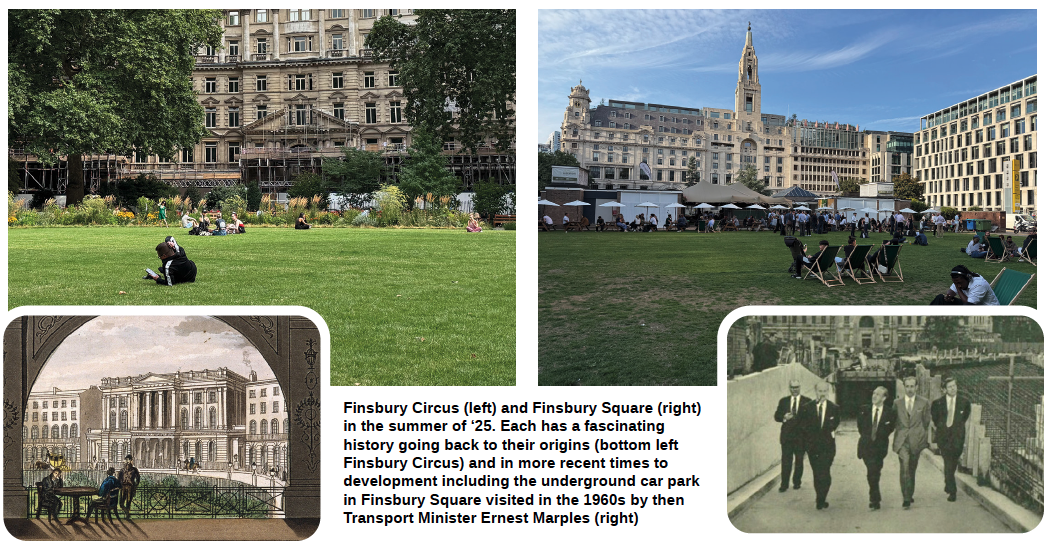
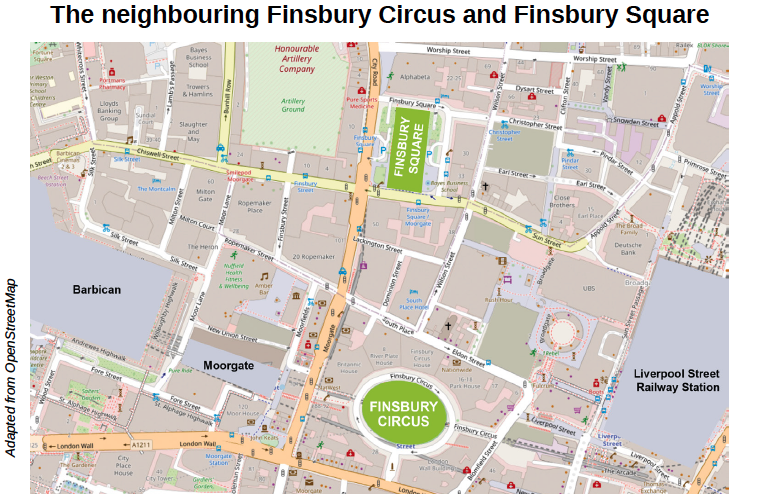
The reason Finsbury Circus had been closed (for over a decade) was that it was a major works site during construction of the Elizabeth Line (Crossrail), its location being above the still relatively new ‘Liverpool Street’ underground station. I place the station name in quote marks because, if you leave its long Elizabeth Line platforms at their western end, you reach the surface through Moorgate station, not Liverpool Street. I know this well, not just through having used both parts of the station many times since it was opened, but also because, around 15 years previously, I worked on the redesign of the public realm at each end.
This knowledge was not, however, proof against me initially doing what I have done before: that is to confuse Finsbury Circus with the nearby Finsbury Square (of which more later). The former is circular (well, oval) and the latter is rectilinear, so, being that they are named in accordance with their shapes, it shouldn’t be too difficult to tell them apart. Nevertheless, their sheer propinquity sometimes makes me immediately think of the one when I should be thinking of the other.
The fact that they’re not both orthogonal is what denied me the simple pleasure of entitling this piece A Tale of Two Squares. And the fact that the Circus is in the City of London and the Square (though only 250m distant as the Corvus corone flies) is in the Borough of Islington, also blew any possibility of going with Charles Dickens’ original book title. As you’ll also see later, it could actually have been A Tale of Two Bowling Greens, but it’s the spaces as a whole – the contrasts between them, and the stories behind them – that inspired this article about the custody and changing use of such important pieces of premium urban open space.
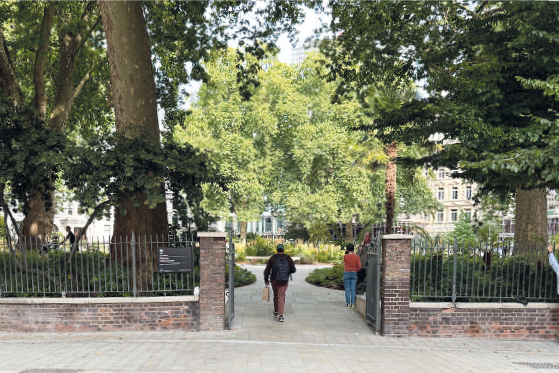
The western gate of the Circus - more or less as it was before, but now with a superior street crossing and a better connection to Moorgate (behind the photographer)
Finsbury Circus, our first port of call (and originally our only intended one), can lay a proud claim to being London’s first designated public park, being opened in 1606. It is also – I’d guess by far – the largest public space in the Square Mile, and is Grade II listed. It took its essential present-day form during the early 19th century, with the layout being the work of architect George Dance the Younger. No, I’d never heard of him, either but he was the fifth (and indeed youngest) of five sons of – you saw it coming – George Dance the Elder, also an architect.
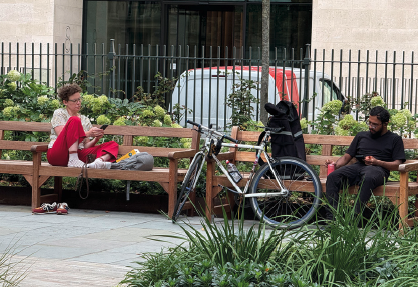
The benches in Finsbury Circus have many uses: as seats, as couches, as bike stands...
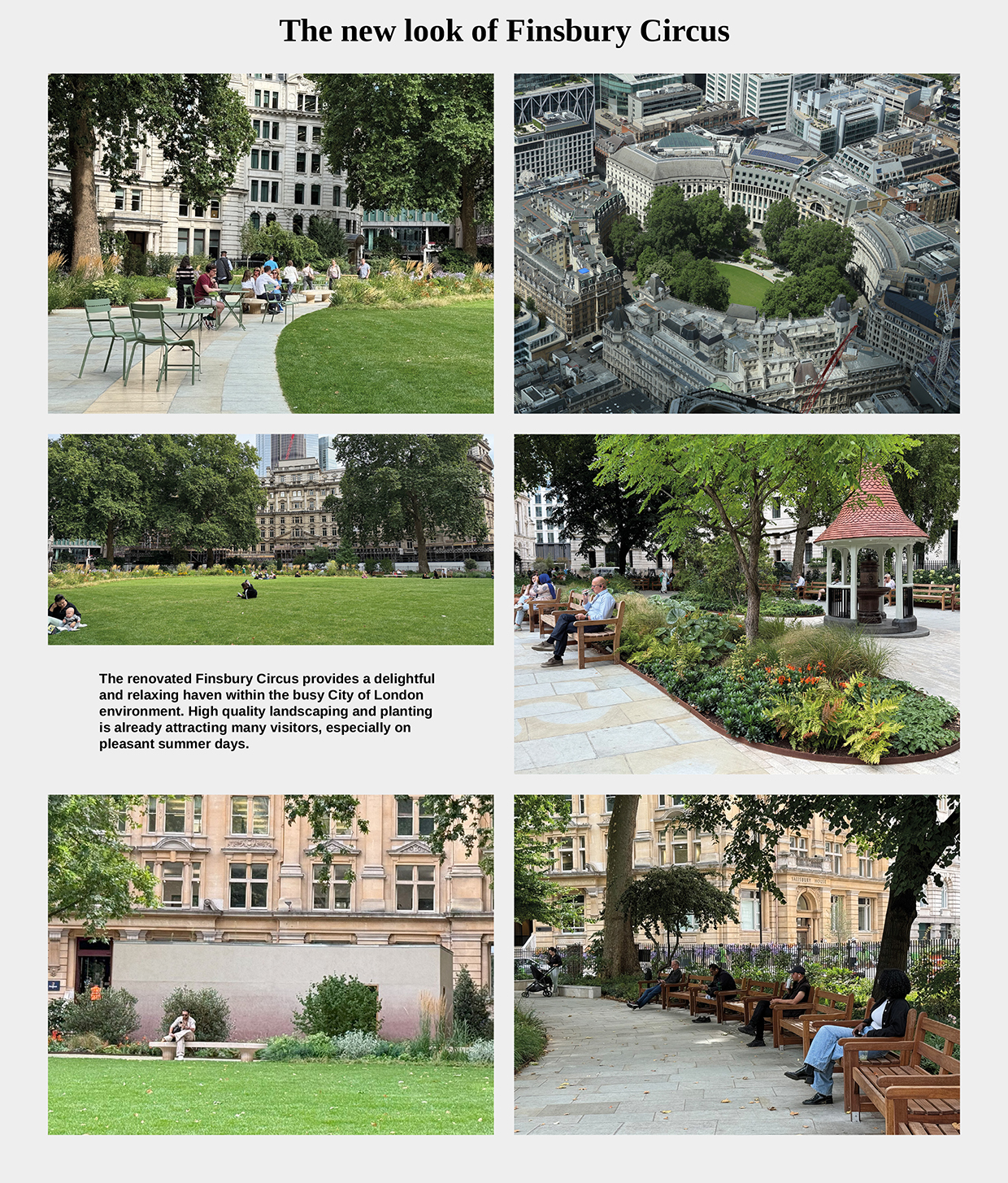
I am happy to report that, in its latest incarnation, Finsbury Circus is a really rather pleasant spot indeed, as I trust the accompanying photographs convey. I mean, it should be great – right? – bearing in mind that sources say it cost £2.8m to re-create. However, I’ve seen similar large sums of money spent on projects that achieve far less in the way of public benefit.
A good deal of detailed thought has obviously been given to its vital roles as both a place to visit and an uplifting stage of any walking trip through this part of the city. There’s a large, grassy, open central space, which is a lovely place to sit or lie, when the turf is dry; there are many old-school wooden benches – very nice places on which to sit upright, or sit cross-legged, or lounge a bit; and there are a few backless stone benches and some blocks of granite (I think) that serve as individual seats or stools. There are even a few table-and-chairs combinations, one of which we commandeered as we took in the sight of people enjoying this fine place on a fine day and chatted of our thoughts arising.
Another aspect of the circus that I like very much are the huge trees which surround the space without seeming to hem it in, and which provided welcome shade on a hot day without having low or dense crowns that would make the place seem dark. The new planting was as well-chosen attractive, varied and lush as one might hope/expect, and the edges of the planted areas were defined by a simple and attractive metal upstand: CorTen steel, I imagine.
The whole public area is separated from the surrounding carriageway – which provides for traffic circulation and some parking without being noticeably busy or dangerous – by a low brick wall surmounted by railings (about six feet high altogether). This boundary is essentially as it was before the space within was transformed. The whole is also mercifully relaxed and restrained: it does not draw attention to itself by shouty features – not that such things are inevitably bad – but invites you simply to come in and enjoy it, whether that’s as you stroll through or as you tarry. As one of the project architects (Je Ahn of Architecture 00 + Studio Weave) has said, the scheme was “fundamentally about the public realm – the City is densely packed and people need space to breathe”.
So far, so what’s-not-to-like? Finsbury Circus is a great place for people, one that might once have been described as an urban lung, or even an oasis. But the Editor and I being the kind of people to whom such questions naturally arise – we wondered (a) if it could be greater and (b) if it might once actually have been even greater.
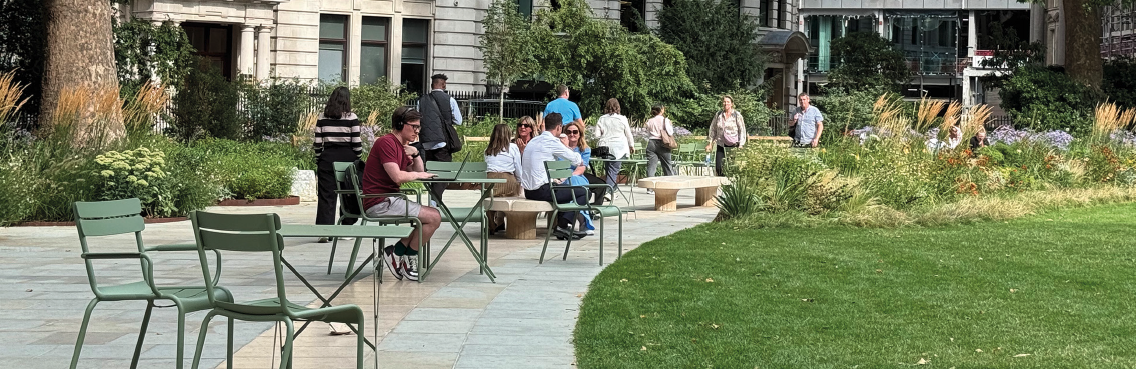
Relaxing in the new Finsbury Circus
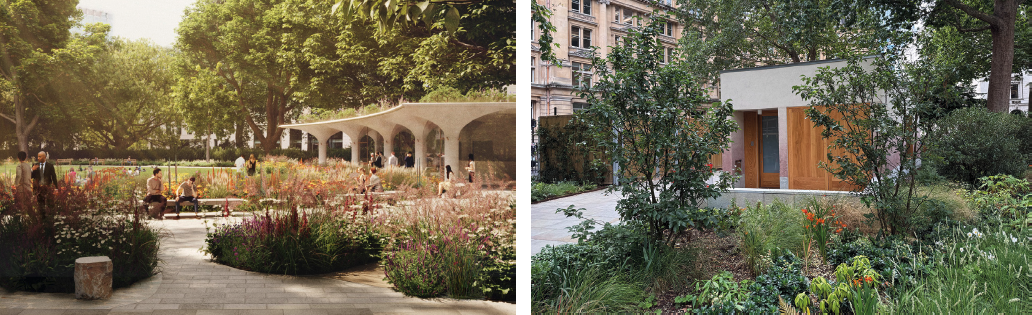
A visualisation of the proposed refreshments pavilion in Finsbury Circus that proved too costly to build, and a photo of the parks office that didn’t.
To help answer these questions, we looked a few things up about the Circus and its past, both there and then (as you can so easily do these days) and subsequently. Perhaps the first thing we discovered was that the original plans for the new Circus included something that, in our view, would decidedly have made it a greater asset for its users: a 100-capacity, open-fronted pavilion café to serve as a social and refreshment hub for the park! It was a warm afternoon, we were both at our leisure, and talking is thirsty work: and it’s a certainty that we would have patronised such a facility, had it been there. Indeed, we proved that fact in due course, at the next stage of our perambulation.
Sadly, however, although the creation of this source of refreshment was thoughtfully included with the scheme that got planning permission, significant increases in build costs saw it subsequently cut from the delivered scheme. I have seen a City of London spokesperson quoted as saying that “dedicated space has been included for the potential use of food trucks and coffee carts”, which we would have accepted as a very reasonable alternative. Regrettably, though, that potential was not being fulfilled during our visit. Frankly, that was a disappointment to us, and surely others.
Although there is no pavilion, there is one new structure in the space – but of less use to ordinary punters like us. This is an office and equipment building for members of the City’s parks department. We didn’t knock, thinking that the undoubted commitment of Corporation officers to public service would stop short of handing out cold beers to strangers. However, we did saunter past the building, and were rewarded by seeing in two of its windows collages of how the Circus had looked in the past. One covered the pre-Crossrail period and the other the during-construction period. Both are informative and my photos of them accompany these words.
So much for what now is there, and what more might have been: what about what had previously existed in the same place? That required a little more intensive research which later unearthed a couple of reports to the City’s Open Spaces and City Gardens Committee which bear upon that question.
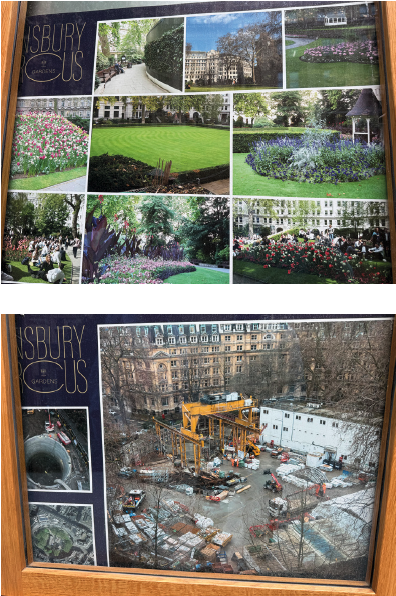
In the parks office windows were photo collages of how the Circus had looked before it was dug up (top) and how it looked mid dig (bottom).
Of these, a 2018 report explains why a 1955 bandstand that had survived the Crossrail upheaval in situ, would nevertheless not be part of the new gardens. Having read the report, I think it’s fair to summarise it as saying, “The bandstand’s a bit naff, it was hardly ever used, and it would cost quite a bit to maintain”. No complaints from me on that score, but if a 70-year-old bandstand is the kind of thing you can’t get enough of, then it will be music to your ears to know that this one was dismantled carefully and has been reconstructed at the Chiltern Open Air Museum, near Chalfont St Giles. This, incidentally, is a rather marvellously typical British enterprise: ‘a charity that rescues threatened historic buildings which would otherwise be demolished, and rebuilds and preserves them in a traditional Chilterns landscape’. Perhaps a prospect for future exploration.
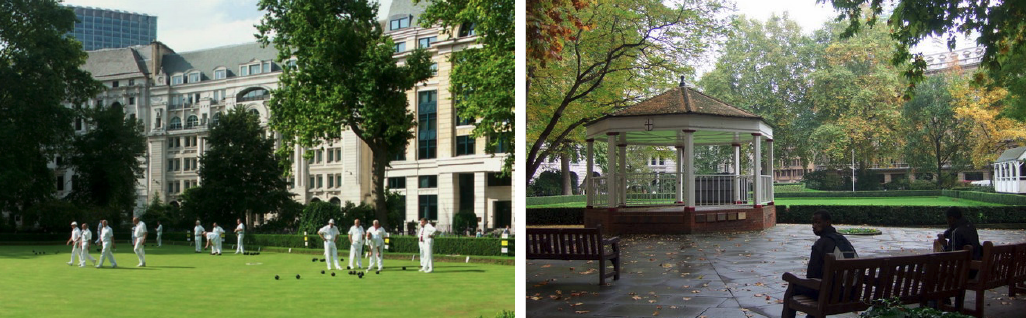
Late lamented? The Finsbury Circus bowling green, and the 1955 bandstand which was taken
down piece by piece and reassembled in the middle of the South Bucks countryside.
An earlier, 2016 report, had asked members “to endorse the reinstatement of Finsbury Circus Garden to be laid out for general public access as a high-quality garden space and without the introduction of specialist sporting surfaces exclusively aimed at specific user groups”. Naturally curious about the wording, the latter half of that clause seemed to scream for our attention. What specialist sporting surfaces could it be referring to, and which user groups might have had exclusive use of them?
Because of my earlier hint, you might already have guessed that this is about a bowling green. The one that existed within the Circus prior to its Crossrail-related closure in 2010 apparently occupied 31% of the space’s area and was run by and for the members of the City of London Bowling Club. What happened to this club while the Circus was being dug up is unclear, but its members were recorded as having been very keen to return from wherever (if anywhere) to which they had been exiled. The City Corporation, however, took the decision that not only was the club’s proposition for returning unaffordable, the priority for the use of that valuable space was not for a comparative few, indulging their sporting pleasures of old, but for the public at large in an area with an increasing daytime population.
Personally, I think the Corporation made the right decision. While a pavilion selling drinks would be an excellent use of a relatively small proportion of the space, giving over almost a third of the Circus for occasional enjoyment by a select group would not be. Besides, as that Committee report pointed out, “It is worth noting that there is a bowling facility at Finsbury Square in the London Borough of Islington, just 250 metres north of Finsbury Circus”.
Quite co-incidentally, and in pursuit of some liquid refreshment rather than a game of bowls, that was precisely where we headed next. It is interesting to reflect on the fact that, had the Circus been provided with its new pavilion, as intended, we may never have gone on to have the instructive experience that prompted me to write this piece.
For some reason, I had thought that Finsbury Square had also had some kind of recent facelift. But I couldn’t have been wronger.
When considered alongside the almost pristine Circus, the larger Square cut a rather sorry figure on our arrival. While almost anywhere would suffer badly by comparison with £3m’s worth of brand new public space delivered by an authority with an already impressive track record of improving its streets and spaces, we had nonetheless both hoped for better. I think we might reasonably have expected it, too, because public space in this part of London is so much at a premium that it can’t afford to be wasted. ‘Affording’, however, seems to be at the root of Islington’s challenge with Finsbury Square.
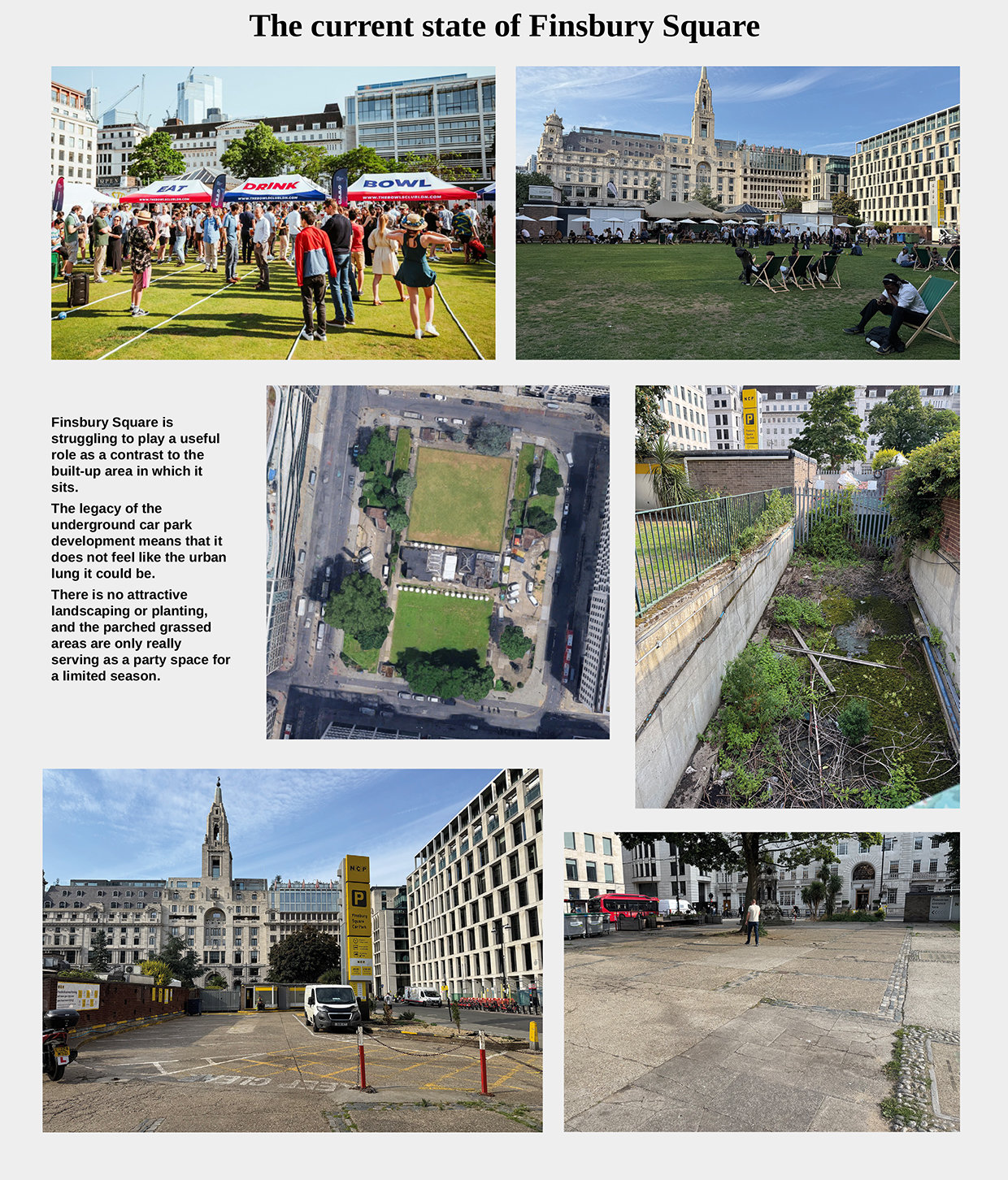
Viewed from above – as indeed a Corvus corone might, having completed the short flight from the Circus – the Square’s layout is quite impressive. It is a substantial rectangle of about 110m by 90m with the long edge running more or less north-south. Considered in portrait orientation, so to speak, the central section, roughly about half the overall width (i.e. 45m) comprises two squares of plain grass to the north and south of a low building cluster of some sort. To either side of this are strips, 20m or so wide, that contain some trees, patches of more grass, some hard paving, some parked vehicles, a few scattered square-shaped structures, and what appear to be ramps. Overall, the impression is less of treasured ‘rus in urbe’ and more of neglect.
Viewed by someone on foot, as we were, the key features are hardly inspiring. The southern of the two large grass squares is, well, just a large plain grass square. Although there are no barriers, it does not invite people to amble through it as part of a local journey and, when we were there, it just had a few deck chairs on it, and a gentleman of uncertain age enjoying a somewhat idiosyncratic exercise routine involving ball-throwing. The northern half of the square is (or, at least, ‘was once’) – and again you’ve surely guessed it – a bowling green. It had the traditional form, but not at all the expected lawn-like quality. Large parts of it were decidedly brown, not green, and it is surely not receiving the upkeep it once did. As for the ‘building’ in the middle, it’s a collection of single storey structures, some having a rather impermanent air.
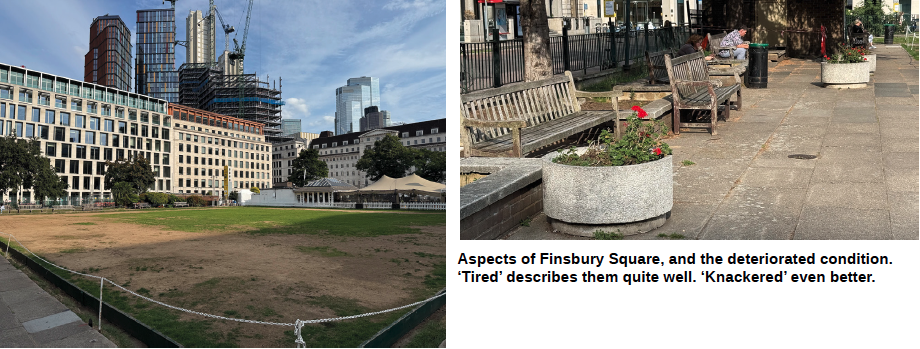
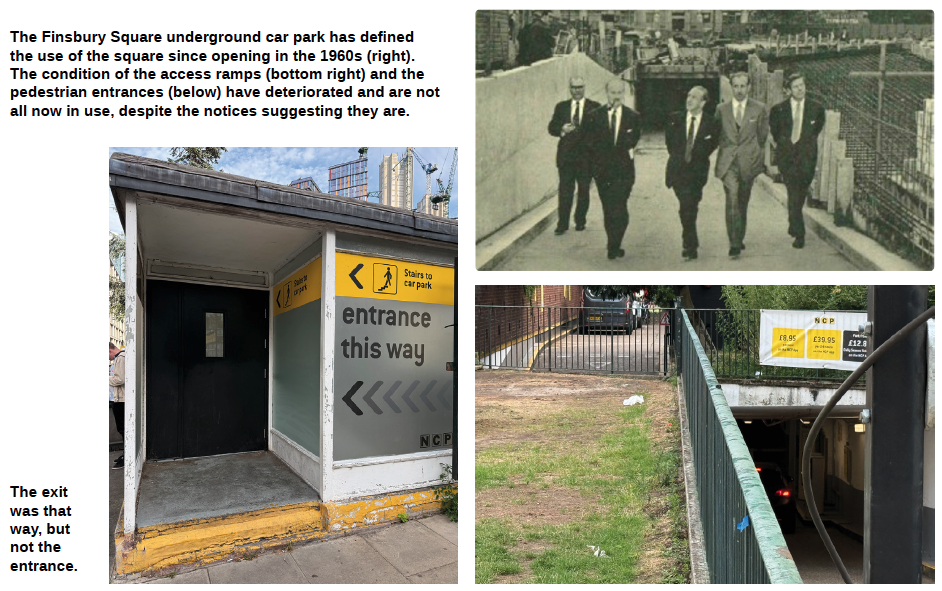
The wide strips to each side are, candidly, a mess; and the chief reason for this is that what appear to be ramps are indeed such, connecting with a subterranean car park. This is, in some respects, the dominant feature of the Square, though mostly invisible. The few scattered square-shaped structures around the periphery turn out to be (or have been) pedestrian access points to/from that car park; while the two areas where parked vehicles can be observed are former petrol filling stations.
It’s what lies beneath that seems to underpin the story of Finsbury Square for the last half century and more. Originally laid out in 1777 as a quadrangle of terraced houses arranged around a central garden, those houses began to make way for much larger commercial properties about a century later. Around half a century later still, in 1931 to be precise, the London Squares Preservation Act was perspicaciously passed to protect specific squares, gardens, and enclosures (including Finsbury Square) from being built upon or used for unauthorised purposes.
However, this Act sadly omitted to control what could or couldn’t happen underneath them. In fact, owners or lessees of the squares were “specifically permitted to use the subsoil for the construction and maintenance of underground works at the same time taking over as much of the surface as may be necessary for the provision of entrances, exits, ventilation shafts, et cetera.” Oh dear, this was loose thinking on someone’s part.
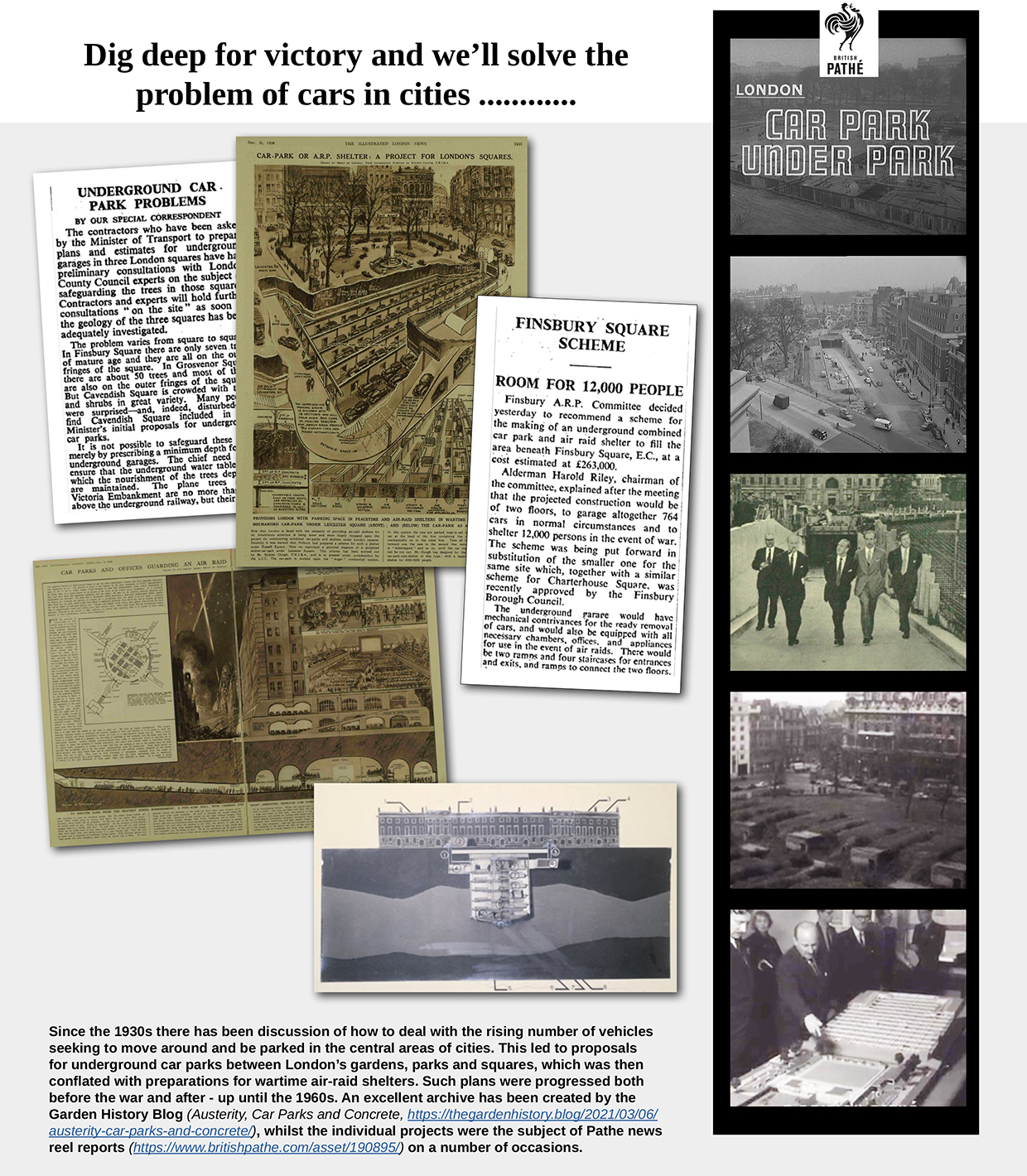
What came next, and very soon, was summarised by an article in the Times from July 1936. The Ministry of Transport announced that “there is absolutely no room left in (Central) London which is available for parking”. If only they could see it now...
The Ministry saw it as its duty “not only palliate the evils of today, but also anticipate the exigencies of tomorrow.” The ‘today’ part was referring to air raid shelters, prompted by the shadow of war, the ‘tomorrow’ to the provision of car parks.
This thinking was not limited to Finsbury Square, as a wave of underground parking developments was to be unleashed - reaching its apogee in the really massive excavation under Hyde Park in April 1962.
Back in June 1939, the then Finsbury Borough Council voted to build an air raid shelter/car park under the Finsbury Square – a space capable of accommodating 12,000 people in the event of war and 764 cars in “normal circumstances”. While the outbreak of war came too soon to allow this decision to be enacted, it did not erase the collective vision of the car park of tomorrow.
My sources report that, in 1956, an application was submitted by Lex Garages to build that car park below the Square, together with a petrol station on the surface. Opposition to this proposal came from several quarters, including the Church Commissioners who had just, that very year, sold the Square to the council for a nominal £50 on the understanding it was in “safe custody for the benefit of the public” as “a proper public garden.” Had they read the London Squares Act carefully, we must wonder? Others objected on the broader grounds that disturbing the land below would create an unwelcome precedent.
The nature of these objections meant that two separate Finsbury Square Acts (of Parliament) had to be passed before the car park and associated works could be built. The Bill for the first was introduced in 1957 and the second Act was passed in June 1959. The car park was finally opened in 1961, and there’s a picture we’ve found of legendary Transport Minister Ernest Marples inspecting the works shortly before their completion. He loved cars, did our Ernest.
The small silver lining was that the Square itself – or what useful parts remained of it once the vehicle ramps, pedestrian access points and petrol stations had been laid out – was refurbished with gardens, a café and the bowling green (which opened in 1962).
Reflecting the thinking of the era of rapid motorisation and the inclination of the public authorities of the time to embrace the car and cater for it (1963’s prescient Buchanan Report notwithstanding), the construction of the underground car park and the associated long lease that the council entered into can now be seen to have been seriously ill-advised. It has certainly had an unfortunate legacy in terms of the public utility of the space above it (and, indeed, the space below).
Whatever its origins, the car park has obviously seen more prosperous days and is, though largely out of sight, something of an eyesore. To gain access to it, because we were naturally drawn to explore it, the Editor and I tried both of the little supposed access structures on the north side of the Square, but were denied. The door of one had a handle, but it simply would not yield to our efforts. The door of the other, despite being clearly pointed towards by large, relatively new signage saying ‘Stairs to car park’, had no handle at all. Both appeared to be for egress only. We therefore entered the netherworld by walking down the only active vehicle entry ramp. There obviously used to be a down ramp and an up ramp on both sides, but those on the east side have clearly been closed off for a good long while, and unattractive detritus of various sorts has gathered in the voids created.
The ramp we used had a sign above it saying ‘Welcome’, so we took that as an invitation.
Our speleological adventure was also something akin to time travel, as we found a place that was once presumably considered the car park of choice for affluent city commuters, but which now seems unlikely to be earning its keep, especially against suitable alternatives in a part of the city where land is so expensive. It’s all very well having eye-watering parking charges that are in keeping with local commercial floorspace rental values, but those rental values are partly due to the excellence of local transport services. So, while parking fees of £9 per hour for each hour from one to four, then £40 for a day, may be theoretically necessary for this space to pay its way, they’re also unlikely to persuade people who know they have other travel options and who will also have to pay the Congestion Charge if they choose to go by car.
Thus, we discovered a cavernous space with very few cars in it. And most of these, judging by the branding of the surrounding pillars and stanchions, were hire cars owned by Sixt. There were, in fact, many more bicycles present than cars. This is the result of the ‘car’ park now being a hub for Port, an e-bike rental provider supplying vehicles to gig workers involved in the food delivery business.
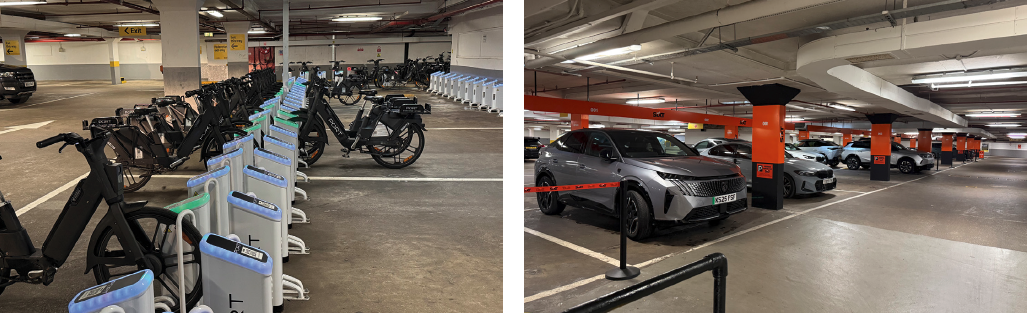
Whether bikes or cars, almost all of the vehicles we found in the Finsbury Square car park appeared to be for hire. It seems that it is not now popular for individuals to simply park their cars down here these days. Habits change – and so have the prices.
I’ve written before of the iniquities of this business (LTT901), which a couple of more recent articles in the Guardian are also bringing to light. So, I’ll say nothing more about this here than to observe that, if people are hiring their bikes from Port, then at least they’re getting a legal and roadworthy one. You can find out more by visiting port.app.
https://www.theguardian.com/news/2025/jun/16/take-urgent-action-to-slow-sales-of-and-dangerous-ebikes-says-group-of-mps-and-peers
https://www.theguardian.com/lifeandstyle/2025/sep/04/britains-e-bike-boom-desperation-delivery-drivers-and-unthinkable-danger
So, what should we make of this weird, buried time capsule? How is it able to be so poorly used, how can its decay be tolerated, in a location where land space is otherwise so intensively used? And how might the Square above it be brought back to useful public life so that it might even rival, or complement, the nearby Circus?
Our later researches revealed that Islington Council has recognised the mistakes of the past, but has found itself unable to address them. This is in large part because, although it owns the freehold, the car park and its ramps (and perhaps also the two surface car parks which turn out previously to have been petrol stations) are subject to a 99-year lease originally granted in 1961 to a company called AG Finsbury Square, and subsequently acquired by property company British Land in August 2021.
A 2006 report to Islington’s Executive, sheds some light on the story. It described the Square as “a key area of open space in the southern part of the Borough” but one that was “in poor condition due to many years of inadequate maintenance and blight caused by two unused petrol filling stations and the operation of the underground car park”. The two former filling stations, incidentally, are now chiefly used for parking vehicles that can’t make the height restriction for the underground element. On the evidence of our visit, they’re as lightly used as their underground partners. The one guy who seemed to be supervising all of the parking, both above and below ground, looked awfully bored.
The report went on to say that “the current layout and conditions constrain the utility of the space, which should provide significantly greater amenity value. Ongoing attempts by officers to bring about regeneration of the Square have resulted in some incremental improvements, but not the major renewal of the public realm needed”.
Accordingly, the year before (2005), the Executive had agreed an ‘innovative strategy’ that involved “reprovision of the existing car park on multiple levels under the northern end of Finsbury Square and construction of a new 2,000-person capacity open span events space under the southern two thirds”. This was to be accompanied by “renewal of the entire public realm including rationalisation of the car park entrances and provision of a new bowling green”, and a landscape brief for this had also been agreed in 2005.
The report noted, however, that the mechanism for achieving this change was complicated, largely because of the number of organisations, in addition to the Council, that had/have a legal interest in the Square. Perhaps we do not need to dwell on how that situation might have come about…
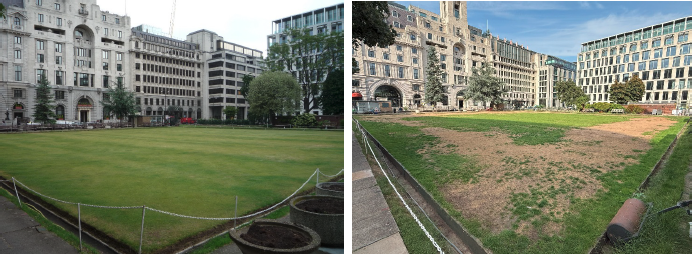
The Finsbury Square bowling green (left, in 2010) and ‘brown’ (right, in 2025)
Twenty years on, and it would sadly appear that none of this ‘innovative strategy’ from the council has been delivered. The whole Square seems tired and in poor repair; as though it has accepted its fate and has given up hoping for the renewal it was once promised. Indeed, if you undertake an internet search for ‘Finsbury Square’ associated with keywords like ‘renewal’ or ‘upgrade’, what you’ll find (or what I’ve found) are numerous references to impressive transformations of the buildings that have the Square as their address. But nothing concrete (perhaps not the ideal word) about the important public space that they all face.
It may not be all doom and gloom, though. It’s easy to be wise after the event, but in a section from the 2006 report seems to hint at the realisation that, even back then, the 2005 strategy to dig deeper for parking at one end of the car park and use the rest for an events space was rather fantastical. This spoke of retaining the option to “revert to the original incremental strategy for the improvement of Finsbury Square if for any reason the current proposals do not proceed as envisaged”.
By contrast, British Land has plans which, while more prosaic, do offer the prospect of the reuse of the space for something that could meet a real, contemporary need. According to a press release issued at about the time it paid £20m for the car park, the acquisition was part of the company’s strategy “to progress development-led urban logistics opportunities in Central London. The car park is close to (our) Broadgate campus and provides an excellent opportunity to create a last mile logistics hub in the City of London where supply for last mile logistics is highly constrained”.
There’s no visible evidence of this plan yet becoming reality, but as ideas for the reuse of an underground city centre car park go, this is one that strikes me as pretty progressive.
But enough of the unfortunate basement. What about the surface plane? Well, the collection of structures in the middle, though on the ramshackle side, are at least in gainful use. Parts may well have been the original premises used by the bowling club, but now – we were relieved to find – they are home to a bar, leased to a commercial hospitality business. While we were glad to give it our custom, it would seem that the terms of that lease are another part of the complex ownership mix that the Council seems at a loss to unpick.
Our feelings about the current state of play at Finsbury Square are perhaps best summed up by the contrast between two photos we show above that I took of the bowling green, from almost the same angle: one in 2010 and the other last month. And yet, despite the pretty terrible current state of repair of this ‘green’, it is seemingly in at least occasional use. Our later use of Google revealed that ‘The Bowls Club’ hosts what it claims to be ‘London’s Ultimate Corporate Summer Party’ on selected dates in June and July (you can book now for 2026, should you wish).
Judging by pictures from the so-called club’s website (thebowlsclubldn.com) and Instagram feed, it appears highly likely that the exhausted look of the green, when we saw it, was the consequence of its peripheral parts having recently played intensive host to temporary bars (housed in gazebos) and been covered in rolls of astroturf to limit the even greater wear and tear that the party-goers would otherwise have inflicted on the surface. The actual bowling, the nominal excuse for the revelry, was restricted to a comparatively small central section, divided into lanes for less than professional use by revellers. Not at all, one imagines, what the white-clad members of the Circus’s City of London Bowling Club would consider acceptable use of hallowed turf.
So, after all our experience of the present and our findings from the past, what should we conclude from this tale of one circus and one square? Forbearing to pass specific judgment on the actions of the ‘powers that be’ from the past, not least because they (unlike us) were denied the benefit of hindsight, perhaps we can draw out some general lessons for those facing similar challenges or opportunities on land designated for public enjoyment, rather than private profit, in our urban centres.
-
We should treasure the open spaces of our urban areas: the delight they can bring; the rest and peace they offer; the chance to reflect history and heritage; how they help us engage with nature; their contribution to biodiversity; the opportunity to people watch and to meet friends; their cleaner air; the array of sights and sounds. This is public value that cannot be priced.
-
Focus on the everyday and on everybody. Ensure that all are welcome and none are excluded. Design for real people doing ordinary things, like sitting, conversing, stopping for just a moment, and walking from A to B. And design for people having ordinary needs, such as to eat and drink and (especially in larger spaces) to use a toilet. Let informal lead formal. Make special and occasional events possible, by all means, but not so that they impinge on the core day-in-day-out function.
-
Related to this, beware the quick buck. For example, I hope that Islington charges ‘The Bowls Club’ a decent fee for their hospitality activity. But, whatever it is, I would actually question whether the use of the bowling green as a party venue for, maybe, 100 hours in a year justifies the space appearing so barren and unloved for the vast majority of the calendar.
-
Cities, especially, are places where change is a constant. For this reason, if no other, it is extremely unwise to invest in infrastructure likely to prove very difficult to adapt in response to changing land values, travel habits or use cultures, however ‘visionary’ the idea (or pressing the apparent need for more parking space).
-
Tempting as it might be, and necessary as it might seem at the time, it is also very unwise for a public authority to restrict its ability to make best public use of its assets by entering into financial and/or legal arrangements that may problematically tie its hands in the future.
-
Not that this is a revelation (though it seems to be a truth often hidden in plain sight), but upkeep of public space is as important as its initial design and physical construction. If the former is not provided for, over the long term, and from the outset, an asset can easily become a liability.
-
Related to the above, looks are important. This isn’t so much about aesthetics as about appearances. If a place seems uncared for by its owner, some users are also likely to treat it badly, and this will only increase the maintenance burden.
-
No public space is an island. Make sure that they’re not only easy to get into and across, but that they’re also well connected to their surrounding streets and buildings. I love how the works to Finsbury Circus extend beyond the main oval itself into the locality, as the accompanying before and after photos of the link to Moorgate show below.
Oh, (need I say this?) and never compromise space for people to provide capacity to feed the voracious appetite of motor vehicles. If there is one over-arching message from my reflections on the Finsburys, it’s that the cliché is true. Cities are, first and foremost, for their citizens; and their wellbeing should be at the heart all the decisions we make. If the demands of traffic seem to be becoming overwhelming, then the motor vehicle needs to be put back in its proper place.
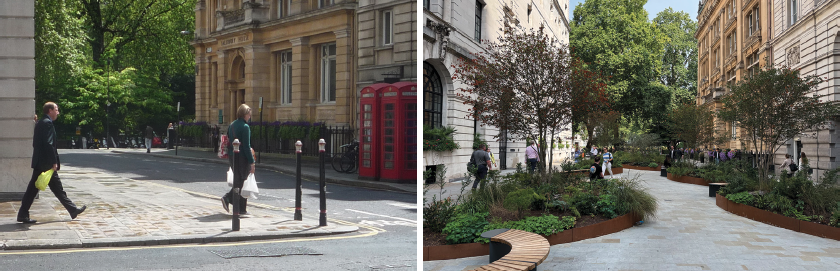
The Finsbury Circus renovation has helpfully extended to nearby access streets, including the link to Moorgate (before and after)
John Dales is a streets design adviser to local authorities around the UK, and a member of several design review panels. He’s a past chair of the Transport Planning Society, a former trustee of Living Streets, and a committee member of the Parliamentary Advisory Council for Transport Safety. He is director of transport planning and street design consultancy Urban Movement.
This article was first published in LTT magazine, LTT923, 2 October 2025.
You are currently viewing this page as TAPAS Taster user.
To read and make comments on this article you need to register for free as TAPAS Select user and log in.

Log in
Read more articles by John Dales
Read more articles on TAPAS
